" height="42.609px" id="Jp5yKR43w" transform="translate(2.363 1.638)" width="42.608999999999995px"/><path d="M 17.497 7.589 C 17.497 7.589 18.998 5.992 18.889 4.095 C 18.779 2.416 17.101 0.465 17.101 0.465 C 17.101 0.465 15.681 2.894 15.777 4.245 C 15.996 6.415 17.524 7.589 17.483 7.589 Z M 22.492 3.453 C 23.175 2.17 22.806 0 22.806 0 C 22.806 0 20.663 1.147 20.172 2.17 C 19.353 3.876 19.954 5.419 19.954 5.419 C 19.954 5.419 21.742 4.914 22.478 3.453 Z M 14.863 6.019 C 14.863 6.019 15.368 4.095 14.44 2.634 C 13.62 1.351 11.45 0.533 11.45 0.533 C 11.45 0.533 11.383 3.098 12.051 4.095 C 13.157 5.773 14.863 6.019 14.863 6.019 Z M 9.267 5.023 C 10.55 5.596 11.697 5.091 11.697 5.091 C 11.697 5.091 11.273 3.74 10.167 3.235 C 9.172 2.771 7.561 3.125 7.561 3.125 C 7.561 3.125 8.489 4.655 9.267 5.009 Z M 8.844 9.472 C 9.731 11.287 11.451 11.792 11.451 11.792 C 11.451 11.792 12.229 9.936 11.491 8.339 C 10.851 6.919 8.749 5.814 8.749 5.814 C 8.749 5.814 8.325 8.38 8.858 9.486 Z M 5.282 10.045 C 6.633 11.083 8.134 10.823 8.134 10.823 C 8.134 10.823 8.025 9.117 6.852 8.189 C 5.814 7.37 3.822 7.302 3.822 7.302 C 3.822 7.302 4.463 9.404 5.282 10.045 Z M 4.927 10.782 C 4.927 10.782 3.931 9.636 2.607 9.636 C 1.433 9.595 0 10.632 0 10.632 C 0 10.632 1.597 11.778 2.498 11.778 C 4.026 11.778 4.927 10.782 4.927 10.782 Z M 7.275 16.419 C 9.24 17.661 11.233 17.129 11.233 17.129 C 11.233 17.129 10.837 14.809 9.172 13.703 C 7.643 12.666 4.927 12.843 4.927 12.843 C 4.927 12.843 6.074 15.627 7.275 16.405 Z M 15.75 12.393 C 16.105 10.687 14.972 8.326 14.972 8.326 C 14.972 8.326 12.912 10.318 12.652 11.669 C 12.256 13.88 13.471 15.449 13.471 15.449 C 13.471 15.449 15.354 14.303 15.75 12.379 Z M 18.111 15.45 C 18.111 15.45 20.349 15.49 21.673 14.058 C 22.847 12.816 23.133 10.209 23.133 10.209 C 23.133 10.209 20.323 10.851 19.394 11.847 C 17.934 13.525 18.111 15.477 18.111 15.45 Z M 20.131 18.125 C 20.131 18.125 21.455 19.804 23.297 19.94 C 24.935 20.05 27.037 18.725 27.037 18.725 C 27.037 18.725 24.894 17.019 23.584 16.938 C 21.482 16.801 20.131 18.111 20.131 18.111 Z M 18.671 18.589 C 16.432 17.989 14.686 19.094 14.686 19.094 C 14.686 19.094 15.723 21.196 17.674 21.769 C 19.421 22.274 21.946 21.305 21.946 21.305 C 21.946 21.305 20.063 18.985 18.671 18.603 Z M 6.852 17.306 C 4.532 17.62 3.358 19.34 3.358 19.34 C 3.358 19.34 5.145 20.868 7.138 20.622 C 8.926 20.404 10.918 18.521 10.918 18.521 C 10.918 18.521 8.285 17.129 6.852 17.306 Z M 0.928 15.423 C 0.928 15.423 2.498 17.101 3.562 17.306 C 5.309 17.661 6.552 16.733 6.552 16.733 C 6.552 16.733 5.623 15.204 4.122 14.849 C 2.798 14.563 0.915 15.423 0.915 15.423 Z M 22.342 6.265 C 20.527 6.77 19.776 8.23 19.776 8.23 C 19.776 8.23 21.346 9.267 22.943 8.871 C 24.335 8.517 25.754 6.811 25.754 6.811 C 25.754 6.811 23.434 5.951 22.328 6.278 Z" fill="rgb(179, 212, 98)" height="21.91479612576767px" id="DOAK4jDKL" transform="translate(9.555 7.629)" width="27.03700051879883px"/><path d="M 13.362 11.465 L 11.082 11.465 L 11.082 2.921 L 7.916 11.478 L 5.487 11.478 L 2.28 2.826 L 2.28 11.478 L 0 11.478 L 0 0 L 3.495 0 L 6.702 8.735 L 9.95 0 L 13.376 0 L 13.376 11.478 Z M 24.336 9.445 L 24.336 11.505 L 15.996 11.505 L 15.996 0.001 L 24.158 0.001 L 24.158 2.035 L 18.316 2.035 L 18.316 4.56 L 22.847 4.56 L 22.847 6.552 L 18.317 6.552 L 18.317 9.405 L 24.335 9.445 Z M 36.277 5.733 C 36.277 9.117 34.135 11.465 30.545 11.465 L 26.165 11.465 L 26.165 0 L 30.545 0 C 34.216 0 36.277 2.239 36.277 5.733 Z M 33.847 5.733 C 33.847 3.413 32.633 1.952 30.422 1.952 L 28.43 1.952 L 28.43 9.499 L 30.422 9.499 C 32.633 9.499 33.848 8.039 33.848 5.719 L 33.848 5.733 Z M 38.229 0 L 40.549 0 L 40.549 11.506 L 38.229 11.506 Z M 50.458 9.049 L 45.258 9.049 L 44.371 11.479 L 41.941 11.479 L 46.472 0 L 49.325 0 L 53.856 11.506 L 51.358 11.506 L 50.471 9.049 Z M 49.707 7.056 L 47.851 2.061 L 45.995 7.056 Z M 10.155 20.977 C 10.155 24.362 8.012 26.71 4.423 26.71 L 0.042 26.71 L 0.042 15.204 L 4.422 15.204 C 8.094 15.204 10.155 17.484 10.155 20.977 Z M 7.766 20.977 C 7.766 18.657 6.552 17.197 4.341 17.197 L 2.348 17.197 L 2.348 24.744 L 4.341 24.744 C 6.551 24.744 7.766 23.284 7.766 20.964 Z M 20.418 24.649 L 20.418 26.709 L 12.079 26.709 L 12.079 15.205 L 20.241 15.205 L 20.241 17.266 L 14.399 17.266 L 14.399 19.832 L 18.93 19.832 L 18.93 21.825 L 14.4 21.825 L 14.4 24.676 L 20.418 24.636 Z M 32.674 15.204 L 28.47 26.71 L 25.55 26.71 L 21.305 15.204 L 23.803 15.204 L 27.01 24.471 L 30.217 15.204 Z M 42.406 24.649 L 42.406 26.709 L 34.066 26.709 L 34.066 15.205 L 42.228 15.205 L 42.228 17.266 L 36.346 17.266 L 36.346 19.832 L 40.876 19.832 L 40.876 21.825 L 36.346 21.825 L 36.346 24.676 L 42.406 24.636 Z M 52.341 24.622 L 52.341 26.723 L 44.179 26.723 L 44.179 15.218 L 46.499 15.218 L 46.499 24.594 L 52.341 24.594 L 52.341 24.635 L 52.341 24.621 Z M 52.942 20.977 C 52.942 17.483 55.221 15.067 58.565 15.067 C 61.908 15.067 64.228 17.388 64.228 20.977 C 64.228 24.567 61.908 26.887 58.565 26.887 C 55.221 26.887 52.942 24.54 52.942 20.977 Z M 61.854 20.977 C 61.854 18.63 60.571 17.087 58.578 17.087 C 56.586 17.087 55.303 18.589 55.303 20.977 C 55.303 23.366 56.586 24.867 58.578 24.867 C 60.571 24.867 61.854 23.339 61.854 20.977 Z M 75.324 18.848 C 75.324 21.128 73.727 22.478 71.052 22.478 L 68.528 22.478 L 68.528 26.723 L 66.207 26.723 L 66.207 15.218 L 71.052 15.218 C 73.727 15.218 75.324 16.61 75.324 18.848 Z M 72.977 18.917 C 72.977 17.77 72.226 17.211 70.807 17.211 L 68.528 17.211 L 68.528 20.636 L 70.807 20.636 C 72.226 20.636 72.977 20.036 72.977 18.93 Z M 90.214 26.723 L 87.935 26.723 L 87.935 18.166 L 84.769 26.723 L 82.339 26.723 L 79.132 18.07 L 79.132 26.723 L 76.853 26.723 L 76.853 15.218 L 80.347 15.218 L 83.554 23.953 L 86.802 15.218 L 90.228 15.218 L 90.228 26.723 Z M 101.16 24.649 L 101.16 26.709 L 92.821 26.709 L 92.821 15.205 L 100.983 15.205 L 100.983 17.266 L 95.1 17.266 L 95.1 19.832 L 99.632 19.832 L 99.632 21.825 L 95.1 21.825 L 95.1 24.676 L 101.16 24.636 Z M 112.884 15.204 L 112.884 26.71 L 110.714 26.71 L 105.186 18.944 L 105.186 26.71 L 102.948 26.71 L 102.948 15.204 L 105.186 15.204 L 110.632 22.97 L 110.632 15.204 Z M 124.567 17.347 L 120.609 17.347 L 120.609 26.723 L 118.288 26.723 L 118.288 17.347 L 114.331 17.347 L 114.331 15.204 L 124.594 15.204 L 124.553 17.347 Z M 2.348 32.524 L 2.348 35.226 L 6.838 35.226 L 6.838 37.191 L 2.348 37.191 L 2.348 41.927 L 0.028 41.927 L 0.028 30.422 L 8.19 30.422 L 8.19 32.482 Z M 8.763 36.196 C 8.763 32.701 11.042 30.286 14.386 30.286 C 17.73 30.286 20.05 32.606 20.05 36.196 C 20.05 39.785 17.73 42.105 14.386 42.105 C 11.042 42.105 8.763 39.785 8.763 36.195 Z M 17.675 36.196 C 17.675 33.848 16.392 32.306 14.399 32.306 C 12.407 32.306 11.124 33.834 11.124 36.196 C 11.124 38.556 12.407 40.085 14.399 40.085 C 16.392 40.085 17.675 38.583 17.675 36.195 Z M 21.838 37.369 L 21.838 30.463 L 24.158 30.463 L 24.158 37.3 C 24.158 39.007 25.154 40.044 26.86 40.044 C 28.566 40.044 29.562 39.006 29.562 37.3 L 29.562 30.463 L 31.882 30.463 L 31.882 37.369 C 31.882 40.249 29.958 42.105 26.86 42.105 C 23.762 42.105 21.838 40.248 21.838 37.369 Z M 44.33 30.463 L 44.33 41.968 L 42.16 41.968 L 36.632 34.202 L 36.632 41.968 L 34.394 41.968 L 34.394 30.463 L 36.632 30.463 L 42.078 38.229 L 42.078 30.463 Z M 57.077 36.196 C 57.077 39.58 54.934 41.927 51.345 41.927 L 46.964 41.927 L 46.964 30.422 L 51.345 30.422 C 55.016 30.462 57.077 32.742 57.077 36.195 Z M 54.688 36.196 C 54.688 33.875 53.474 32.415 51.263 32.415 L 49.27 32.415 L 49.27 39.962 L 51.263 39.962 C 53.474 40.002 54.688 38.542 54.688 36.182 L 54.688 36.195 Z M 65.743 39.553 L 60.544 39.553 L 59.656 41.982 L 57.227 41.982 L 61.758 30.477 L 64.611 30.477 L 69.142 41.982 L 66.644 41.982 L 65.757 39.552 L 65.743 39.552 Z M 64.993 37.519 L 63.137 32.524 L 61.281 37.519 Z M 78.177 32.565 L 74.219 32.565 L 74.219 41.941 L 71.899 41.941 L 71.899 32.565 L 67.941 32.565 L 67.941 30.463 L 78.163 30.463 L 78.163 32.565 Z M 79.596 30.463 L 81.916 30.463 L 81.916 41.968 L 79.596 41.968 Z M 83.909 36.196 C 83.909 32.701 86.188 30.286 89.532 30.286 C 92.876 30.286 95.196 32.606 95.196 36.196 C 95.196 39.785 92.876 42.105 89.532 42.105 C 86.188 42.105 83.909 39.785 83.909 36.195 Z M 92.78 36.196 C 92.78 33.848 91.497 32.306 89.505 32.306 C 87.512 32.306 86.229 33.834 86.229 36.196 C 86.229 38.556 87.512 40.085 89.505 40.085 C 91.497 40.085 92.78 38.583 92.78 36.195 Z M 107.029 30.463 L 107.029 41.968 L 104.859 41.968 L 99.331 34.202 L 99.331 41.968 L 97.093 41.968 L 97.093 30.463 L 99.331 30.463 L 104.777 38.229 L 104.777 30.463 Z" fill="rgb(5, 6, 6)" height="42.104999343872066px" id="l_KSG_Lyf" transform="translate(52.464 1.924)" width="124.59400128173829px"/></g></g></svg>)

ARTIFICIAL INTELLIGENCE IN THE UKRAINIAN MEDIA: Integration, Challenges, and Sector Needs
Artificial intelligence (hereinafter referred to as "AI") is increasingly becoming part of newsroom workflows around the world. However, the practical application of these technologies often differs from the public discourse surrounding them. Media organizations use AI to address a range of highly practical challenges, including saving time, automating routine tasks, and improving efficiency in the face of limited resources.
At the same time, one respondent in this study observed:
“As I answer the questionnaire, with every page I realize just how little our team knows about the possibilities AI has to offer.”
This response reflects the broader situation across the sector. For many Ukrainian newsrooms, the exploration of AI is only just beginning, and its adoption often involves not only identifying new tools but also discovering the full range of opportunities these technologies can provide.
This report examines how Ukrainian local and niche media outlets are currently using AI tools, the tasks for which they are applied, the barriers limiting the broader adoption of AI, and the opportunities that remain underexplored by newsrooms. It also includes a review of publicly available sources (desk research), encompassing both academic research and professional and industry publications on the use of AI in the media. This provides a broader context for the findings by situating the Ukrainian experience within international practices, debates, and approaches to AI adoption.
The study is guided by three research questions:
How are Ukrainian media outlets integrating AI into their workflows, and what patterns of adoption—or non-adoption—are emerging across the sector?
Which organizational, technical, financial, and ethical barriers have the greatest impact on AI adoption in newsrooms?
What knowledge, resources, and support mechanisms do media organizations need to further develop their use of AI?
The following sections present the study's main findings and highlight the key trends shaping the adoption of artificial intelligence in Ukrainian media.
Ukrainian newsrooms are in the early stages of AI adoption. Today, AI is used primarily to streamline day-to-day operations and reduce staff workload, rather than to enable new editorial approaches or transform business models.
Its most common applications involve familiar (routine) tasks, ranging from interview transcription and translation to SEO optimization.
Text-related tasks dominate AI use
Text-based tasks represent the primary area of AI adoption among Ukrainian local media. According to the study, 85% of newsrooms use AI tools for:
proofreading;
headline generation;
paraphrasing content;
editing and refining copy.
Newsrooms rely primarily on general-purpose AI models such as ChatGPT, Claude, and Gemini, largely because of their accessibility and ease of use.
AI is used less frequently for visual content. Approximately half of the surveyed newsrooms use it to generate illustrations, while AI applications in video production remain limited and are largely confined to technical tasks, such as video editing and automatic subtitle generation.
More advanced applications—including audience analytics, fact-checking, project management, and workflow coordination—remain relatively uncommon.
Strong interest, limited strategic adoption
High interest in AI has not yet translated into a systematic approach to its adoption. Although 57% of newsrooms reported discussing AI as a strategic priority, structured planning remains rare.
Only:
27.5% of newsrooms have a documented AI policy;
22.5% have designated a staff member responsible for AI adoption;
In most cases, these responsibilities are assigned to the editor-in-chief in addition to their existing duties.
Newsrooms are well aware of the risks associated with AI, particularly misinformation and model hallucinations. However, mechanisms for managing these risks remain underdeveloped. Many media organizations lack policies for disclosing AI-generated content or internal procedures governing its use.
Financial and skills-related barriers remain the greatest obstacles
Financial constraints are the most frequently cited barrier to wider AI adoption. Sixty percent (60%) of respondents reported insufficient funding for paid subscriptions and professional AI tools. Only 42% of newsrooms have a dedicated AI budget, and these budgets are generally modest.
The second most significant barrier is the lack of knowledge and practical skills. Fifty-five percent (55%) of newsrooms reported that journalists often lack expertise in prompt engineering and a broader understanding of current AI capabilities. As a result, learning is driven primarily by self-education and individual experimentation.
Infrastructure also limits adoption. Many newsrooms operate with outdated equipment, limited licenses for professional software (including Microsoft Office, Adobe, Notion, Trello, and Slack), and ongoing power outages caused by the war. Under these conditions, even expanding basic AI use becomes difficult.
Ethical concerns further shape adoption. Some respondents fear that excessive reliance on AI could erode journalistic skills, weaken critical thinking, and reduce audience trust in news content.
Many newsrooms remain unaware of AI's full potential
The study shows that AI adoption in Ukrainian media is largely experimental and intuitive. Most newsrooms use AI for a limited set of familiar tasks but have only a partial understanding of the broader capabilities of modern AI technologies.
For many organizations, the challenge extends beyond learning how to use individual tools. Newsrooms are often unaware of capabilities that are already available and therefore cannot identify which editorial processes could be improved or optimized through AI.
As one respondent noted:
"With every section of the questionnaire, I realize how much we don't know."
This observation reflects a broader reality: for many Ukrainian newsrooms, AI remains not only a new technology but also a field whose potential applications and practical use cases have yet to be fully understood.
At the same time, this represents one of the sector's greatest opportunities. For many media organizations, the next stage of AI adoption will involve not only learning to use individual tools but also identifying where AI can meaningfully improve editorial quality and operational efficiency.
The findings also reveal a clear relationship between the duration of AI use and the level of integration. Newsrooms that began experimenting with AI one or two years ago now use it far more extensively and systematically than recent adopters.
Training is the sector's greatest need
Although newsrooms view financial and staffing constraints as equally important barriers, their support needs tell a different story.
Eighty-five percent (85%) identified training and practical skills development as their highest priority, compared with:
60% seeking better access to AI tools and services; and
42% seeking financial support for subscription costs.
The survey suggests that many Ukrainian local media outlets have already moved beyond the initial stage of becoming familiar with AI. Their needs are increasingly shifting toward specialized support tailored to real newsroom workflows, professional roles, and editorial tasks.
The most frequently requested forms of support include:
advanced training focused on specific editorial workflows rather than the basic use of general-purpose AI tools;
mentoring during the implementation of new AI-enabled workflows and tool configuration;
role-specific training programs designed for journalists, editors, designers, and other newsroom professionals.
Overall, the media sector's focus is gradually shifting from asking "What is AI?" to "How can AI be effectively integrated into everyday newsroom operations?"
To place the study's findings in context, this section provides an overview of publicly available sources on the use of artificial intelligence (AI) in the media. The review encompasses academic research, professional publications, industry reports, and practical case studies on AI adoption in newsroom operations.
The purpose of this review is not only to synthesize existing knowledge on the use of AI in the media sector but also to identify the key trends, approaches, opportunities, and challenges currently shaping discussions among researchers and media practitioners.
A detailed description of the methodology used to identify, select, and analyze the sources is provided in the Methodology section at the end of this report. To ensure transparency and reproducibility, the report also includes a set of Appendices following the Methodology section.
The review of non-academic sources reveals that AI adoption in news organizations is driven primarily by practical rather than transformational objectives. Across the 16 sources included in the review, AI is consistently presented as a means of optimizing routine tasks, improving operational efficiency, and strengthening the capacity of resource-constrained newsrooms. Rather than fundamentally rethinking editorial processes, media organizations tend to use AI to improve existing workflows and address immediate operational needs.
The most widely adopted AI applications include transcription (speech-to-text), translation, search engine optimization (SEO), text editing, and adapting content to a newsroom's editorial style. These use cases appear consistently across both international and Ukrainian media organizations, making them the most mature and widespread forms of AI adoption currently documented in newsroom practice. (Thurman et al., 2025; Borchardt, 2025; Lambertini et al., 2026; Oganov, 2025; Pynda, n.d.; Lasii, n.d.)
The adoption of AI for visual and audio content is considerably less widespread and demonstrates greater variation across news organizations. Some Ukrainian media outlets use AI to generate website illustrations, edit video, create subtitles and timestamps, produce AI-generated songs based on news stories, and experiment with AI avatars for social media platforms such as TikTok. Internationally, editorial policies differ substantially. For example, The New York Times encourages journalists not to use AI-generated images except when illustrating the capabilities of the technology itself. AI-generated audio narration has also emerged as a common application in both Ukrainian and international newsrooms, with several organizations using machine learning models trained on the voices of their own journalists. (Tani, 2025; Lviv Media Forum, n.d.; Oganov, 2025; Lasii, n.d.-a, n.d.-b, n.d.-c; Pynda, n.d.-b.)
For most of these applications, news organizations rely on commercially available AI tools developed by companies such as OpenAI, Anthropic, Google, and Amazon, alongside a growing number of open-source alternatives. While proprietary tools such as ChatGPT and Claude are valued for their accessibility and ease of use, open-source models are often preferred because they provide greater control over privacy, reduce dependence on major technology providers, and allow organizations to mitigate concerns about model bias in journalistic work. (Tani, 2025; Oganov, 2025; Pynda, n.d.-a.)
At the same time, a growing number of news organizations are developing proprietary AI solutions tailored to their own editorial needs. These include tools for summarizing articles, generating editorial briefs, adapting content for different audience segments, monitoring global news, and supporting investigative journalism through custom machine learning models. However, these initiatives also illustrate the limitations of newsroom-developed AI systems. Audience-facing chatbots designed to search archives or answer questions about published content can quickly become outdated in the fast-moving news environment or generate inaccurate responses, ultimately reducing audience trust. As a result, some news organizations have deliberately chosen not to develop chatbots in order to preserve their editorial voice and journalistic values. (Tani, 2025; Oganov, 2025; Lambertini et al., 2026; Lasii, n.d.-a; Sun, 2025; Pynda, n.d.-a; Adami et al., 2026.)
As AI becomes more deeply integrated into newsroom operations, questions of governance and organizational strategy become increasingly important. Evidence from the literature presents a mixed picture. While only one-third of surveyed news organizations had an AI strategy in 2023, more recent studies suggest that some organizations have made substantial progress in developing ethical guidelines and internal governance frameworks, whereas others continue to report a lack of clear AI policies. (Beckett & Yaseen, 2023; Thurman et al., 2025; Borchardt, 2025.)
Lambertini et al. (2026) identify three broad approaches to AI adoption in newsrooms: using AI to work faster, by accelerating existing tasks such as transcription; more, by increasing content production; and differently, by enabling fundamentally new editorial activities. The literature suggests that the first two approaches dominate current newsroom practice, while transformative applications remain relatively rare. Most organizations continue to adopt AI reactively, responding to immediate operational demands rather than pursuing long-term strategic transformation. One notable exception is investigative journalism, where AI is increasingly used to analyze large datasets and support complex reporting. Despite these limitations, many organizations—particularly smaller newsrooms—report that AI has significantly strengthened their editorial capacity and operational resilience. (Lambertini et al., 2026; Pynda, n.d.-a; Adami et al., 2026.)
A total of 446 academic articles were identified, including five published in Ukrainian. Following the screening process, 236 articles (including four in Ukrainian) were deemed relevant to the research topic and included in the analysis. Academic sources were identified and screened using Google Scholar. A detailed description of the search strategy, selection criteria, and screening process is provided in the Methodology section.


To assess the relevance of the identified articles, we used large language models (LLMs) as an initial screening tool. The performance of two LLMs—OpenAI and Anthropic—was evaluated against manually annotated data using three standard classification metrics: accuracy, precision, and recall. The results are presented in the table below.
Metric
OpenAI
Anthropic
Accuracy
79.6%
67.4%
Precision
33.3%
23.8%
Recall
100%
100%
As shown in the above table, the OpenAI model achieved higher accuracy than the Anthropic model, while both models demonstrated relatively low precision but perfect recall. Low precision indicates that some articles classified by the models as relevant were, in fact, irrelevant. In contrast, perfect recall indicates that all genuinely relevant articles were successfully identified.
For the purposes of this study, maximizing recall was more important than maximizing precision, as avoiding false negatives—that is, excluding genuinely relevant studies—was considered the higher priority. The models' perfect recall therefore justified the use of LLM-assisted screening to process the large volume of search results. Notably, both models identified the same set of articles as relevant.
Based on an in-depth review of 34 articles (14% of all relevant publications), the researcher developed a thematic framework consisting of nine thematic groups:
Journalists' and Stakeholders' Attitudes Toward AI
Practical and Structural Barriers
Support Mechanisms for AI Adoption
AI Adoption Frameworks
AI Applications in Investigative Journalism
Ethical Debates on AI
AI Adoption Practices
Industry-Wide Implications of AI for the Media
Media Framing and Public Discourse on AI
The thematic groups were defined as follows:
Practical and Structural Barriers encompass organizational, financial, technical, and infrastructural obstacles to AI adoption in newsrooms. This category excludes ethical concerns and attitudinal factors, which are captured separately.
AI Adoption Practices cover descriptive, empirical studies examining how and to what extent AI is currently used in newsrooms and media organizations.
Ethical Debates on AI include discussions of fairness, accountability, editorial independence, and journalistic integrity in the context of AI. Practical barriers are excluded, even when discussed from an ethical perspective.
Industry-Wide Implications of AI for the Media address the broader impact of AI on the media industry, including changes in markets, labor, and business models. Unlike AI Adoption Practices, this category focuses on sector-wide developments rather than newsroom-level applications.
Support Mechanisms for AI Adoption include practical measures designed to facilitate AI adoption, such as training programs, policy interventions, and institutional support. Theoretical models are excluded and classified under AI Adoption Frameworks.
Journalists' and Stakeholders' Attitudes Toward AI capture empirically documented opinions, perceptions, and attitudes of journalists, editors, and other media stakeholders. This category is applied only when these attitudes are explicitly measured or reported, rather than inferred.
AI Adoption Frameworks include studies whose primary contribution is a structured and reproducible framework or model for AI adoption. Unlike Support Mechanisms for AI Adoption, this category focuses on conceptual frameworks rather than practical recommendations.
AI Applications in Investigative Journalism cover the use of AI in investigative reporting, including document analysis, data processing, and source verification. General newsroom applications of AI are classified under AI Adoption Practices.
Media Framing and Public Discourse on AI include studies that examine how AI is represented in public or journalistic discourse, with a particular focus on rhetoric, narratives, and framing rather than on practical applications.
The researcher manually assigned one or more thematic groups to each of the 34 articles. The same articles were subsequently classified by two large language models (LLMs) to evaluate the consistency of the classifications. The results are presented in the table below.
Metric
OpenAI
Anthropic
Jaccard coefficient
62.99%
53.63%
Primary-group accuracy
58.82%
61.76%
Precision
82.35%
57.84%
Recall
63.97%
88.48%
Rows with no matches
14.7%
2.9%
A detailed description of the metrics is provided in the “Methodology” section.
As shown in the table, the two models exhibit different classification strategies. OpenAI adopts a more conservative approach, assigning fewer thematic groups to each article. This results in higher precision but lower recall, as the model identifies fewer of the thematic groups assigned by the researcher. In contrast, Anthropic takes a broader approach, assigning more thematic groups per article. This pattern is also reflected in the average number of thematic groups assigned per article: on average, OpenAI assigns fewer thematic groups than the human researcher, whereas Anthropic assigns approximately twice as many as OpenAI.
Source
Researcher
OpenAI
Anthropic
Average number of thematic groups
1.68
1.18
2.47
Overall, the Anthropic model more closely matched the researcher's classification while also assigning additional, closely related thematic groups. For example, when the researcher assigned only "Journalists' and Stakeholders' Attitudes Toward AI," the model often also assigned "Ethical Debates on AI." Moreover, Anthropic produced only one completely mismatched classification (2.9%), compared with five (14.7%) produced by OpenAI.
For the remainder of the analysis, we use the classifications generated by the Anthropic model. In the context of analyzing the thematic distribution of the literature, failing to identify a relevant theme is considered a more critical error than assigning an additional, closely related one. Consequently, the model's higher recall was prioritized over higher precision.
Neither model achieved high accuracy in identifying the primary thematic group, with Anthropic reaching the highest accuracy of 61.76%. This is largely attributable to the semantic overlap between the thematic categories. Many articles address multiple closely related topics—for example, AI adoption practices and practical and structural barriers—making it difficult to identify a single dominant theme. As a result, the researcher and the models may legitimately differ in their assessment of an article's primary thematic focus.

As shown in the error matrix, the categories AI Adoption Practices and Practical and Structural Barriers were most frequently confused. In some cases, the model identified Practical and Structural Barriers as the primary category, whereas the researcher identified AI Adoption Practices, and vice versa. Overall, AI Adoption Practices proved to be the most challenging category to classify, as it frequently overlapped with other themes, including AI Applications in Investigative Journalism, Ethical Debates on AI, Industry-Wide Implications of AI for the Media, and Journalists' and Stakeholders' Attitudes Toward AI.
Although the models' accuracy in identifying the primary thematic group was relatively modest, only one article in the sample showed a complete mismatch between the thematic groups assigned by the researcher and those assigned by the model. Taken together, the evaluation metrics and the researcher's assessment indicate that the model-generated classifications are sufficiently reliable for the purposes of the subsequent analysis.

The graph illustrates the distribution of thematic groups across the reviewed literature, with each article assigned to one or more categories. AI Adoption Practices represents the largest thematic group, followed by Ethical Debates on AI, Practical and Structural Barriers, and Journalists' and Stakeholders' Attitudes Toward AI. The prominence of these themes reflects the current focus of the literature on the practical applications of AI and the ethical and operational challenges associated with its adoption.
In contrast, more theoretical topics—such as AI Adoption Frameworks, Industry-Wide Implications of AI for the Media, and Media Framing and Public Discourse on AI—as well as niche areas such as AI Applications in Investigative Journalism, account for a considerably smaller share of the literature.
A notable finding is the imbalance between research on barriers and research on solutions. While Practical and Structural Barriers account for 18.9% of all thematic assignments, only 5.9% of the reviewed articles focus on Support Mechanisms for AI Adoption. This suggests that the current body of literature devotes substantially more attention to identifying obstacles than to proposing practical approaches for overcoming them.

The co-occurrence graph illustrates how frequently the thematic groups appear together within the same articles. Each node represents a thematic group, while the thickness of the connecting lines indicates the frequency with which two themes co-occur. Three categories exhibit the highest eigenvector centrality scores: AI Adoption Practices (0.52), Ethical Debates on AI (0.49), and Practical and Structural Barriers (0.49). This indicates that these themes occupy a central position in the literature and frequently overlap. In contrast, Media Framing and Public Discourse on AI appears to be a more peripheral topic, suggesting that it represents a niche area of research rather than a dominant trend within the current literature.

We also analyzed the specific barriers to AI adoption most frequently discussed in the literature. As shown in the graph, the most commonly cited challenge is distrust of AI, accounting for 24.2% of all identified barriers. This category includes concerns about model bias, transparency, accountability, misinformation, and the overall reliability of AI systems.
The second most frequently discussed category (18.9%) concerns the impact of AI on journalism itself. The literature highlights both practical concerns—such as the potential replacement of journalists, job displacement, and the erosion of professional skills—and broader questions related to editorial autonomy, creativity, and the future of the profession. General ethical concerns are included within this category.
Financial and resource constraints rank third (16.8%), encompassing not only the cost of subscriptions and AI services but also limited infrastructure, restricted access to technology, and dependence on external technological providers. Closely following are gaps in AI skills, training, and literacy (14.3%), reflecting both the shortage of specialized training opportunities and journalists' limited understanding of AI capabilities.
Political, regulatory, and strategic barriers (9.8%) and organizational and cultural resistance (9.6%) are mentioned with similar frequency. The former includes legal issues—particularly copyright and intellectual property—along with the absence of clear regulatory and organizational frameworks and broader geopolitical inequalities in access to AI technologies. Organizational resistance, in contrast, stems from the tension between emerging technological practices and traditional journalistic values, resistance to changes in established workflows, and the operational challenges of integrating AI into existing newsroom processes.
Language and localization barriers account for 4.6% of all identified barriers. These include both technical challenges, such as recognizing underrepresented languages and regional accents, and broader sociocultural issues related to linguistic diversity, preserving cultural authenticity in AI-generated content, and representing local perspectives.
Finally, strategic challenges represent the smallest category (less than 2%). These barriers relate primarily to organizational preparedness, the absence of established approaches to integrating generative AI into newsroom operations, and internal organizational bureaucracy.
Given that Ethical Debates on AI and Journalists' and Stakeholders' Attitudes Toward AI are among the most prominent thematic groups identified in the literature (19.9% and 15.2%, respectively), it is unsurprising that concerns about the reliability of AI and its implications for journalistic autonomy emerge as the most frequently discussed barriers to AI adoption.
Overall, the review of academic and non-academic literature suggests that AI adoption in newsrooms is driven primarily by pragmatic considerations and the need to improve efficiency, particularly in resource-constrained environments. Current applications focus predominantly on automating existing workflows, while more transformative uses of AI—and broader strategic rethinking of journalistic practice—remain relatively uncommon.
It is important to note, however, that this review primarily reflects the international body of research and professional literature. The Ukrainian context may differ substantially from these broader trends. The following section therefore examines the results of our survey of Ukrainian newsrooms to explore how AI is being adopted within Ukraine's media landscape.
The survey included 40 Ukrainian newsrooms, interviewed between May and June 2026. Of these, 23 were small newsrooms (up to 10 staff members), 8 were medium-sized (10–19 staff members), and 9 were large organizations (20 or more staff members).

Most participating media outlets were based in Kyiv and the Kyiv region (10 outlets), with nine located in the city of Kyiv. However, it is important to note that Kyiv-based media organizations do not necessarily have a regional focus and often serve a nationwide audience. The next most represented regions were Dnipropetrovsk (four outlets), followed by Khmelnytskyi and Kharkiv (three outlets each). No participating media organizations were based in the Rivne, Ternopil, Ivano-Frankivsk, Odesa, or Zaporizhzhia regions, nor in the temporarily occupied Donetsk and Luhansk regions or the Autonomous Republic of Crimea. Overall, 70% of respondents identified their organizations as online-only media outlets.

The survey findings indicate that AI adoption in Ukrainian newsrooms is still at an early and largely intuitive stage. Although more than half of the surveyed newsrooms (57%) reported discussing AI as a strategic priority, its adoption remains cautious and largely unsystematic. Only 27.5% have a documented AI policy, and none of the participating newsrooms has developed a comprehensive AI adoption strategy.
Beyond a small number of AI pioneers that have integrated AI across multiple newsroom functions, Ukrainian media organizations generally approach the technology with caution. AI is used primarily as a practical tool for routine tasks, including text editing, SEO optimization, image generation, audio transcription, and machine translation. General-purpose large language models (LLMs), such as ChatGPT, Gemini, and Claude, dominate newsroom workflows because they are readily accessible and require minimal technical expertise.
In contrast, AI plays only a limited role in more complex or strategically important activities. Applications such as audience analytics, content personalization, distribution, financial management, advanced fact-checking, and project management remain rare. Many respondents acknowledged that they had been unaware of AI's potential in these areas prior to participating in the survey but expressed strong interest in learning more.
Several factors continue to constrain AI adoption:
Infrastructure limitations. Many newsrooms operate with outdated equipment, face disruptions caused by the war, and lack access to essential licensed software. In many cases, organizations are not fully aware of which digital tools they need.
Limited awareness of AI capabilities. Many newsrooms have only a superficial understanding of the range of AI applications currently available. This is unsurprising, given that approximately half of the surveyed organizations began experimenting with AI only within the past few months—or are only now beginning to do so. As a result, AI adoption is often driven by experimentation rather than strategic planning. Many organizations are unable to identify which tools they lack, even for non-AI-related work, and continue to face broader shortcomings in digital infrastructure and access to basic productivity software.
Limited funding and training. Only 42% of media organizations allocate funding for paid AI subscriptions, while just 10% have a dedicated budget for staff training. As a result, most AI-related skills are acquired informally through self-directed learning or free online courses.
Ethical and professional concerns. Respondents expressed significant concerns about misinformation, AI hallucinations, the erosion of journalistic skills, and an increasing reliance on AI that could diminish creativity and critical thinking.
Despite these challenges, more than half of the surveyed media organizations (55%) actively monitor how their peers are adopting AI and are interested in experimenting with both established and emerging applications, including AI-generated news presenters and automated analytics. At the same time, concerns about AI—even when well founded—often discourage media professionals from exploring its broader potential. For many Ukrainian newsrooms, AI remains an "unknown unknown": they are not only unfamiliar with more advanced AI applications but are often unaware that such capabilities exist and could substantially improve their editorial workflows and organizational performance.
Ukrainian newsrooms remain at an early stage of AI adoption, characterized by experimentation rather than strategic planning. In most organizations, AI integration is driven by individual initiative and enthusiasm rather than by formal strategies, dedicated budgets, or structured training programs. At the same time, newsrooms are actively observing their peers and demonstrate a strong willingness to expand the use of AI in their editorial operations.
Only 27.5% of surveyed newsrooms have a documented AI policy, and none reported having a formal AI adoption strategy. Nevertheless, more than half (57%) discussed AI as a strategic priority during the past year. Only 22.5% have designated a staff member responsible for evaluating and implementing AI tools, and in most cases this responsibility falls to the editor-in-chief. A further 12% reported actively testing or evaluating AI tools as part of their newsroom's strategic development.
Most newsrooms (60%) rely on external resources to build AI capabilities, combining several learning formats. The most common approaches include self-directed learning through online courses (35%) and articles (30%), participation in professional communities (43%), consultations with experts (18%), and commercial training programs (10%). However, only 10% of organizations have a dedicated training budget, meaning that AI skills are acquired primarily through freely available resources.
Only 32% of surveyed organizations have established structured internal learning processes. In most newsrooms, AI knowledge develops organically through self-study or the efforts of individual staff members—most often the editor-in-chief. At the same time, respondents expressed a clear need for more systematic capacity building, emphasizing that AI should become an integrated part of daily newsroom operations rather than being adopted on an ad hoc basis.
Financial investment in AI also remains limited. Only 42% of news organizations allocate a budget for paid AI subscriptions. Among all respondents, 12.5% reported spending between $5 and $50 per month, 15% allocated $50–$200, while only 8%—equivalent to three of the forty surveyed newsrooms—reported a comparatively substantial AI budget.
Overall, newsrooms approach AI with cautious optimism. Sixty percent have established ethical guidelines governing its use, including internal restrictions and policies on disclosing AI-generated content to audiences. Sixty-two and a half percent have discussed the risks associated with AI. The most frequently cited concerns include misinformation, AI hallucinations, excessive reliance on AI, the erosion of journalistic skills, and the potential decline of creativity and critical thinking. Respondents also expressed concern that AI-generated content could weaken editorial quality or undermine a newsroom's distinctive editorial voice.
More than half of the surveyed organizations (55%) actively follow the experiences of other newsrooms implementing AI. Respondents expressed interest in learning about both practical applications—such as SEO optimization and image editing—and more advanced use cases, including AI-generated presenters, automated video production, newsroom chatbots, donor reporting, proposal writing, audience analytics, AI-powered content recommendations, and the integration of AI into content management systems. Many organizations also look to the AI policies of other media outlets when developing their own internal guidelines.
Overall, half of the surveyed newsrooms (50%; calculated after excluding responses of "hard to say") began experimenting with AI only within the past few months, are just beginning to adopt it, or have not yet started. Nine percent (9%) reported not using AI at all, while nearly half (47%) considered their current use of AI to be minimal.
The findings also reveal a clear relationship between the maturity of AI adoption and its level of use. Newsrooms that began experimenting with AI one to two years ago are significantly more likely to report moderate or advanced levels of adoption, whereas organizations that started more recently generally report limited or no AI use. This suggests that AI integration is a cumulative process, with experience playing a key role in moving from experimentation to more systematic adoption.

Overall, AI adoption in Ukrainian newsrooms has yet to become part of a coherent strategic vision. Although many organizations are actively experimenting with AI, the key components of successful adoption—editorial policies, dedicated budgets, designated staff, and structured training—remain fragmented rather than integrated into a comprehensive organizational strategy. At the same time, cautious and sometimes skeptical attitudes toward AI tend to shift the focus from long-term development to managing potential risks. Nevertheless, the positive relationship between the length of AI adoption and the level of its use suggests that integration is a gradual, cumulative process. Newsrooms that began experimenting with AI earlier have progressed toward more mature and systematic adoption. Taken together, these findings suggest that most Ukrainian media organizations are still in the process of developing a strategic vision for the role of AI in their editorial workflows.
The adoption of artificial intelligence to support newsroom workflows remains at an early stage in Ukrainian media organizations. AI is used extensively only for meeting transcription, while its application to more strategic functions—such as project management, CMS integration, and employee onboarding—remains limited. This pattern reflects broader infrastructure constraints, including outdated hardware, insufficient access to licensed software, war-related power outages, and the absence of structured AI training in most newsrooms. As a result, many organizations struggle not only to adopt AI but also to identify the technologies and capabilities they need to support their long-term development.
Only 52% of surveyed newsrooms have the basic digital infrastructure required to support collaborative work, including access to platforms such as Slack, Microsoft Office, and Adobe. Overall, 42% rate their technical capacity as good or very good, while 27.5% consider it inadequate. Another 25% responded "hard to say"; notably, 70% of these organizations (7 out of 10) lack even basic digital infrastructure. This suggests that some newsrooms may not recognize infrastructure limitations as a structural barrier to digital transformation.
Access to essential digital tools is also associated with a more positive assessment of technical capacity. Among newsrooms with access to collaboration platforms and licensed software, 66.6% rated their technical capacity as good or very good. Among organizations without such tools, this figure drops to just 21.1%.
Many newsrooms are unable to identify the specific technological solutions that could improve their operations, pointing to a disconnect between digital infrastructure and strategic planning. Only a small number of respondents could clearly articulate which tools they were missing. The primary constraints remain insufficient funding for licensed software and limited financial resources more broadly. Respondents also highlighted fundamental infrastructure challenges, including unstable electricity supply, the need for backup power solutions such as EcoFlow, and the need to modernize hardware, particularly computers.

As shown in the chart, 62% of surveyed newsrooms use AI in their operational workflows exclusively for transcribing meetings. Other operational functions—including workflow automation, CMS integration, project management, and employee onboarding—continue to be performed primarily without AI support. This highlights that AI adoption remains concentrated in low-risk, well-established use cases, while its integration into more complex operational processes is still limited. The most commonly used AI transcription tools are presented below.


The graph illustrates the use of AI across different stages of content production, alongside the presence or absence of newsroom AI policies and the use of AI for fact-checking.
Overall, AI adoption across all content formats follows a consistent pattern: newsrooms use AI primarily to improve the efficiency of existing workflows rather than to fundamentally transform content production. Across text, images, audio, and video, AI is most commonly applied to low-risk, well-defined tasks such as editing, summarization, transcription, subtitling, and illustration generation. More complex or strategically sensitive applications—including content analysis, fact-checking, large-scale video generation, and systematic data analysis—remain relatively uncommon.
These findings point to a model of cautious AI adoption, in which AI is widely used as a productivity tool but is rarely entrusted with tasks requiring editorial judgment, interpretation, or strategic decision-making. Coupled with the absence of formal AI strategies in most newsrooms and the widespread reliance on general-purpose LLMs such as ChatGPT, Gemini, and Claude, this suggests that AI adoption remains largely experimental. Rather than serving as a catalyst for rethinking editorial processes, AI is primarily viewed as a versatile tool for supporting existing workflows.
Eighty-five percent (85%) of surveyed newsrooms use AI to support text-related tasks, including editing, proofreading, paraphrasing, headline generation, and content summarization. However, these applications remain largely instrumental, focusing on improving the efficiency and quality of existing editorial processes rather than automating or transforming content creation itself.

As shown in the chart, AI is used in text workflows primarily for editing, proofreading, restructuring content, generating headlines, and summarizing text. Machine translation is also widely adopted, consistent with findings from previous international studies (Borchardt, 2025; Beckett & Yaseen, 2023). More advanced applications remain uncommon. Only 10% of surveyed newsrooms use AI to analyze background materials or support research during content production, while just 5% employ AI to summarize large information streams, identify newsworthy content, or assess compliance with journalistic standards. SEO optimization, fact-checking, and transcription are not discussed here, as these applications are examined separately in other sections of the survey.
The chart below also shows that general-purpose LLMs dominate text-related workflows. ChatGPT, Gemini, and Claude are the three most widely used tools, substantially outperforming specialized writing assistants such as Grammarly, OnlineCorrector, and LanguageTool. A smaller number of newsrooms also use AI-powered research tools, including Perplexity and NotebookLM, to support information retrieval and content analysis.

Nearly half of the surveyed newsrooms (47.5%) use AI for translation. ChatGPT is the most frequently used translation tool, although dedicated machine translation services such as DeepL and Google Translate also account for a substantial share of usage.

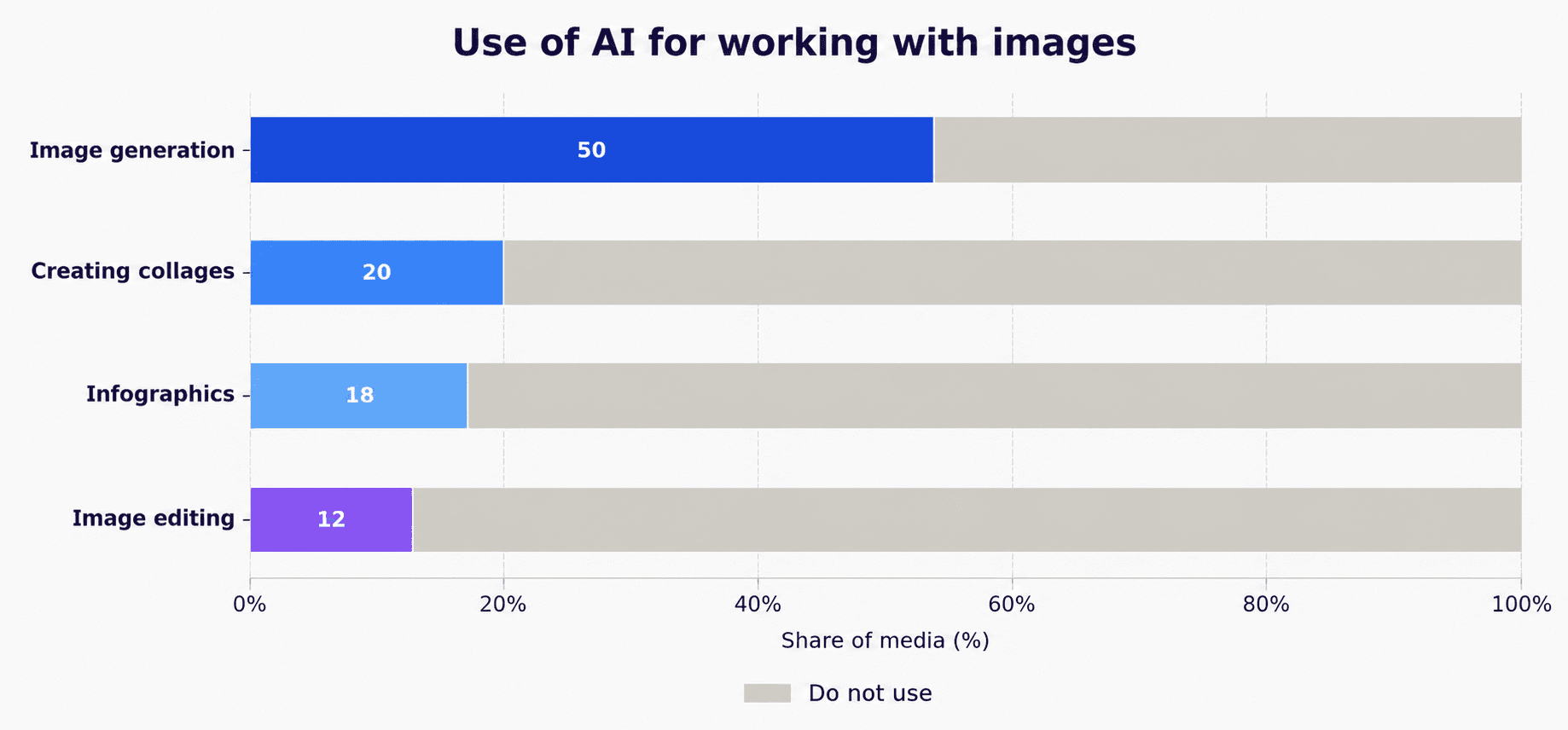
Half of the surveyed newsrooms use AI to generate images, primarily to create lead visuals or illustrations for news stories when photographs are unavailable or when abstract or background imagery is needed. AI is also used to produce entertainment content and create collages or collage elements. In addition, 20% of respondents reported using AI to create infographics, while 12% use it for image editing tasks such as photo restoration, image rotation, and image enhancement. A further 18% reported using AI to support infographic production, including the creation of maps.

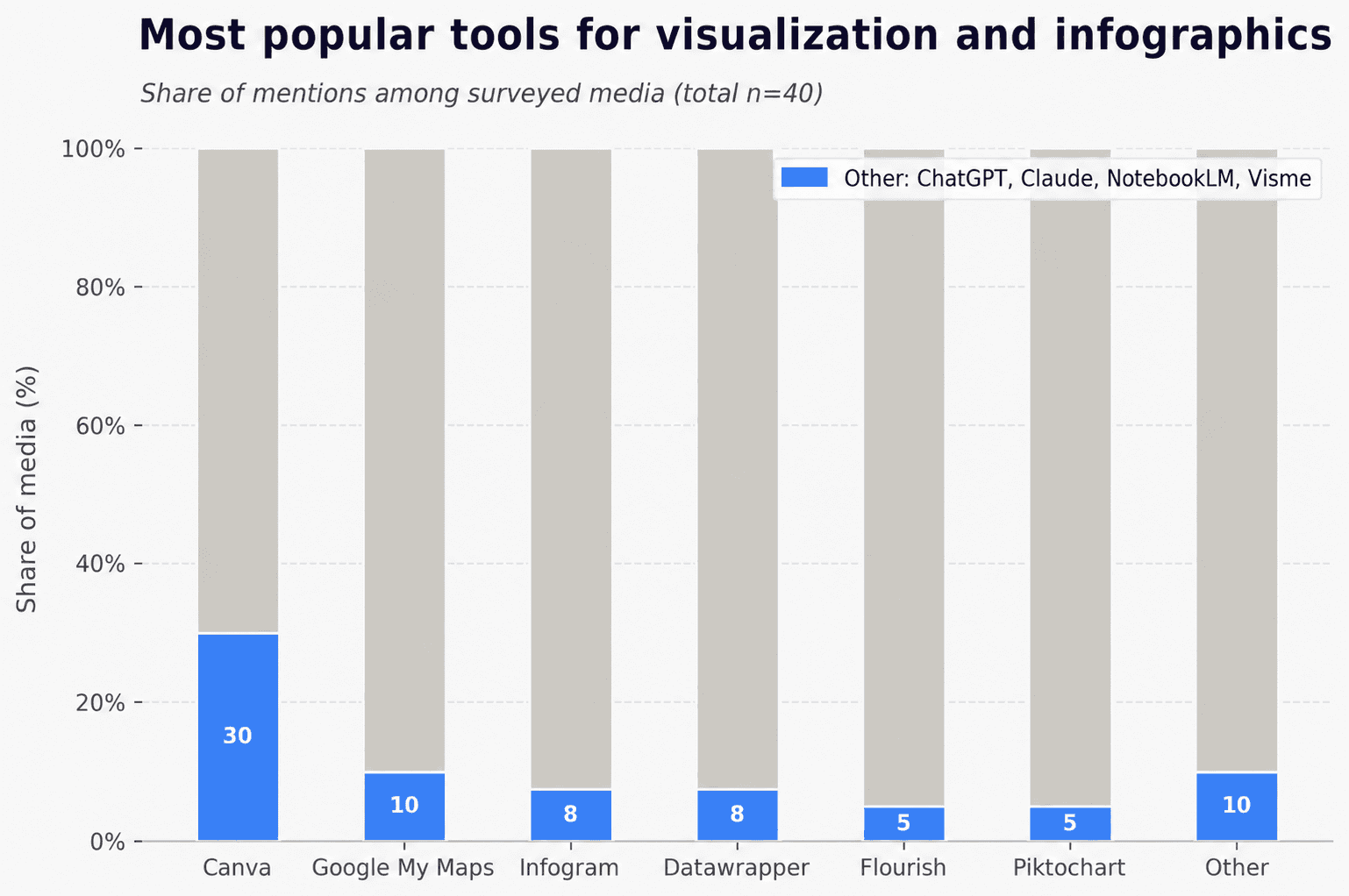
As shown in the chart, image-generation models are the most widely used AI tools for visual content creation. NanoBanana is the leading dedicated image-generation model, while general-purpose LLMs and multimodal tools—including ChatGPT, Adobe Firefly, Claude, and Gemini—are widely used for both image generation and editing. In contrast, more specialized applications, such as PhotoRoom and Canva, are used considerably less frequently.

The survey identified three main areas of AI use in video production: post-production tasks, such as editing and background removal (17%); supporting production tasks, including subtitle generation and AI voice-overs (20%); and video generation, including AI-generated videos and image animation (18%).
Unlike image generation, where AI has become a widely adopted production tool, newsrooms remain considerably more cautious about AI-generated video. Current applications are used primarily for illustrative or entertainment purposes—for example, creating fictional scenarios such as "What if Harry Potter lived in our city?"—rather than for mainstream editorial content.

This distinction is also reflected in the choice of tools. Newsrooms primarily rely on one of two categories of applications: video editing and production software, such as CapCut, DaVinci Resolve, InShot, and Descript, or AI content-generation platforms, including ElevenLabs, HeyGen, and Kling.

AI adoption in audio production remains limited and is concentrated almost exclusively on transcription.

Among the surveyed newsrooms, Google Pinpoint is the most widely used tool. Applications such as AI voice synthesis and audio generation remain comparatively rare.


Among the newsrooms that use AI for fact-checking, the technology is employed primarily to identify and retrieve primary sources. Only two newsrooms (5%) reported using AI for actual verification—that is, comparing editorial content against original sources to assess factual accuracy. Given that only 28% of surveyed newsrooms use AI for fact-checking, while 18% responded "hard to say," the findings suggest that AI remains a relatively conservative tool in this area. Newsrooms appear far more comfortable using AI to support information retrieval than to delegate the verification process itself.
Overall, AI adoption in content production remains focused on practical, task-specific applications. Newsrooms are most likely to use AI where it serves as a reliable productivity tool, including proofreading and editing text, transcribing audio, generating illustrative images, and subtitling or editing video content.

AI adoption declines markedly when it comes to more complex or higher-stakes applications that require greater editorial judgment, such as AI-generated video (including virtual presenters) or document analysis. Instead, local newsrooms primarily use AI as a decision-support tool, relying on it for recommendations while retaining human oversight of core editorial processes. Fully automated content production remains the exception rather than the norm.
Across a range of applications—including text production, image generation, and fact-checking—newsrooms rely on a combination of general-purpose LLMs, such as ChatGPT, Gemini, and Claude, alongside specialized AI tools. Although LLMs are capable of supporting a wide variety of editorial tasks, their widespread use may also reflect the low barriers to experimentation rather than systematic AI adoption. This contrasts with international trends, where audio and video production have emerged as strategic priorities for AI investment (Lambertini et al., 2026). Among Ukrainian newsrooms, however, AI adoption in these areas remains comparatively limited.
A notable finding is the disconnect between newsrooms' awareness of AI-related risks and the institutional mechanisms in place to manage them. Sixty-two percent (62%) of surveyed organizations lack policies for disclosing AI-generated content, while 72.5% have no documented policy governing AI use—let alone a broader AI strategy—even though many respondents identified misinformation and AI hallucinations as major concerns. This creates a paradox: newsrooms recognize the risks associated with AI while actively using it in areas they also perceive as particularly vulnerable to misinformation, such as image generation. As a result, awareness of AI risks often discourages broader adoption without translating into formal governance mechanisms. This pattern is likely explained by the relatively early stage of AI adoption in many Ukrainian newsrooms, where AI is still used sporadically rather than as part of a deliberate and systematic organizational strategy.

AI adoption in content distribution remains limited and largely confined to a small number of well-established use cases. While 68% of surveyed newsrooms use AI to support SEO and social media optimization, and 20% use it to adapt long-form content into short-form video, other applications have seen little uptake. Respondents frequently cited limited experience, insufficient staff capacity, and a lack of practical knowledge as barriers to broader adoption. Many acknowledged that they would like to develop these capabilities, with some stating simply, "We don't know how to do that yet" or "We don't use it at all." Several newsrooms also emphasized the importance of maintaining human oversight of AI-generated content, particularly to prevent overly clickbait-oriented headlines and ensure editorial quality.

General-purpose LLMs, particularly ChatGPT, Gemini, and Claude, are the primary tools used for SEO optimization, social media optimization, and adapting content into short-form video.

AI is also used only to a limited extent for audience analytics and engagement. Although 42% of surveyed newsrooms reported using AI for analytics, 96% of them (23 out of 24) rely on Google Analytics—a long-established analytics platform that predates the widespread adoption of LLMs. Only 28% of newsrooms use these insights to inform editorial decisions, such as selecting topics, content formats, or distribution platforms for future investment.
One respondent's comment illustrates the limited awareness of AI's broader analytical capabilities:
" width="47.33333333333333px"><path d="M 0 0 L 47.333 0 L 47.333 48 L 0 48 Z" fill="transparent" height="48px" id="W2udTHOBx" width="47.33333333333333px"/><path d="M 39.9 7.442 C 39.882 7.33 39.866 7.218 39.85 7.106 L 39.798 7.118 C 38.93 3.052 35.324 0 31 0 C 26.03 0 22 4.03 22 9 C 22 13.97 26.03 18 31 18 C 31.446 18 31.874 17.932 32.3 17.87 C 32.162 18.334 32.02 18.806 31.792 19.23 C 31.564 19.846 31.208 20.38 30.854 20.918 C 30.558 21.5 30.036 21.894 29.652 22.392 C 29.25 22.876 28.702 23.198 28.268 23.6 C 27.842 24.02 27.284 24.23 26.84 24.526 C 26.376 24.792 25.972 25.086 25.54 25.226 C 25.124 25.398 24.76 25.546 24.462 25.67 C 23.858 25.92 23.514 26.064 23.514 26.064 L 24.482 29.942 C 24.482 29.942 24.918 29.838 25.676 29.654 C 26.058 29.558 26.524 29.446 27.054 29.312 C 27.596 29.212 28.174 28.938 28.818 28.688 C 29.452 28.402 30.19 28.212 30.874 27.754 C 31.562 27.318 32.356 26.954 33.056 26.37 C 33.734 25.768 34.552 25.246 35.156 24.482 C 35.816 23.766 36.468 23.014 36.974 22.158 C 37.56 21.342 37.958 20.446 38.378 19.56 C 38.747 18.69 39.059 17.798 39.314 16.888 C 39.788 15.124 40 13.448 40.082 12.014 C 40.15 10.578 40.11 9.384 40.026 8.52 C 39.998 8.159 39.956 7.8 39.9 7.442 Z M 17.9 7.442 C 17.882 7.33 17.866 7.218 17.85 7.106 L 17.798 7.118 C 16.93 3.052 13.324 0 9 0 C 4.03 0 0 4.03 0 9 C 0 13.97 4.03 18 9 18 C 9.446 18 9.874 17.932 10.3 17.87 C 10.162 18.334 10.02 18.806 9.792 19.23 C 9.564 19.846 9.208 20.38 8.854 20.918 C 8.558 21.5 8.036 21.894 7.652 22.392 C 7.25 22.876 6.702 23.198 6.268 23.6 C 5.842 24.02 5.284 24.23 4.84 24.526 C 4.376 24.792 3.972 25.086 3.54 25.226 C 3.124 25.398 2.76 25.546 2.462 25.67 C 1.86 25.916 1.516 26.06 1.516 26.06 L 2.484 29.938 C 2.484 29.938 2.92 29.834 3.678 29.65 C 4.06 29.554 4.526 29.442 5.056 29.308 C 5.598 29.208 6.176 28.934 6.82 28.684 C 7.454 28.398 8.192 28.208 8.876 27.75 C 9.564 27.314 10.358 26.95 11.058 26.366 C 11.736 25.764 12.554 25.242 13.158 24.478 C 13.818 23.762 14.47 23.01 14.976 22.154 C 15.562 21.338 15.96 20.442 16.38 19.556 C 16.749 18.686 17.061 17.794 17.316 16.884 C 17.79 15.12 18.002 13.444 18.084 12.01 C 18.152 10.574 18.112 9.38 18.028 8.516 C 17.998 8.157 17.955 7.798 17.9 7.442 Z" fill="rgb(179, 223, 93)" height="29.941999999999997px" id="DbnziQ40t" transform="translate(4 9.333)" width="40.116454504849365px"/></g></svg>)
"As I answer the questions in this survey, with every page I realize just how little our team knows about the possibilities of using AI. For example, we didn't know that AI could be used to personalize content recommendations, support analytics, or improve audience engagement."
Survey respondent (open-ended response)
Despite the generally limited adoption of AI for audience engagement, a small group of AI pioneers is already experimenting with more advanced applications. Examples include AI agents that monitor information sources and generate headlines, bots that deliver location-specific news alerts, and recommendation systems that personalize article suggestions for individual readers. These early adopters also use AI to segment audiences and engage with them through Telegram bots, for example by answering readers' questions, collecting feedback, and facilitating other forms of audience interaction.

However, as the chart illustrates, these advanced applications remain rare. In most of the use cases described above, only two of the 40 surveyed newsrooms reported adopting AI at this level. More broadly, many respondents acknowledged that, prior to completing the survey, they had been unaware of the range of AI applications available for audience analytics and engagement. At the same time, many expressed a strong interest in developing these capabilities, suggesting that the analytics section of the survey generated the greatest interest among participating newsrooms.

AI adoption in financial management follows the broader patterns observed throughout the study. Its use remains largely task-oriented, and—with the exception of a small number of AI pioneers—its potential remains largely untapped. The most common applications involve supporting tasks traditionally performed by staff, particularly drafting grant proposals and providing machine translation for communication with international partners.
As shown in the chart, AI remains only marginally integrated into financial management. Even in areas such as stakeholder relationship management and presentation development, AI is used primarily for routine support tasks, including translation, data visualization, and basic cross-checking of financial reports. Only a small number of newsrooms reported more advanced applications, such as identifying prospective donors, matching organizational profiles with donor priorities, and monitoring funding opportunities offered by institutional donors.
The survey findings highlight a range of interrelated factors that constrain AI adoption in local newsrooms. Some of these barriers stem from limited financial, technical, and human resources, while others reflect gaps in knowledge, skills, and experience in working with AI technologies.
Additional challenges arise in organizational planning, risk management, and adapting to the rapid pace of technological change. For analytical purposes, the identified barriers can be grouped into the following broad categories:
Financial barriers
Skills barriers
Organizational and strategic barriers
Technical barriers
Psychological barriers and Ethical concerns
Barriers associated with the rapid evolution of AI technologies

Financial constraints were the most frequently cited barrier to AI adoption, identified by 24 newsrooms (60%). A lack of knowledge and skills among staff followed closely, with 22 respondents (55%) identifying it as a major challenge.
Strategic barriers related to planning and defining AI use cases were reported by 14 respondents (35%), while 13 newsrooms (32.5%) cited technical challenges, particularly the complexity of integrating AI into existing workflows and the lack of appropriate digital infrastructure.
At the same time, six respondents (15%) were unable to identify specific barriers. A small number of respondents (2.5% each) highlighted more individual challenges, including uncertainty about the appropriateness of AI adoption, the rapid pace of technological change, and the absence of a clear vision for AI's potential applications.
Overall, the findings indicate that the most significant barriers to AI adoption in news organizations are financial and human-capital constraints, while technical and strategic challenges, although important, are perceived as somewhat less critical. This finding is consistent with earlier survey results showing that 55% of participating newsrooms do not have a dedicated budget for AI tools or AI-related training.
While these results identify the main categories of barriers, they do not explain the specific challenges underlying each of them. To address this, respondents were invited to describe, in their own words, the obstacles they encounter when adopting and using AI in their newsrooms.
As discussed above, financial constraints emerged as the most frequently cited barrier to AI adoption, appearing consistently in both the closed-ended and open-ended survey responses. Respondents associated this challenge not only with the cost of AI subscriptions but also with broader resource limitations that restrict experimentation, staff training, and investment in technical infrastructure.
Many participants emphasized that free versions of AI tools are insufficient for professional use, while paid services remain financially inaccessible for many local and regional news organizations.
"We don't have a budget for AI tools, and the free versions are limited in functionality, licensing terms, and permitted uses. In addition, because of our heavy workload, we simply don't have time to develop our technical skills."
Survey respondent (open-ended response)
Several respondents also noted that their organizations rely primarily on project-based funding and, in some cases, volunteer work. Under these conditions, investing in AI technologies is often viewed as a lower priority than maintaining day-to-day newsroom operations.
The second major barrier to AI adoption is the lack of knowledge and practical experience. In their open-ended responses, many participants noted that staff often have only a limited understanding of the capabilities of modern AI tools and tend to use them only for the basic applications discussed earlier.
"From a staffing perspective, neither I nor many of my colleagues really know how to integrate AI into our work. New tools and improved versions are constantly being released, and keeping up with them is a challenge. The team is somewhat resistant to change, and it's difficult to explain why we should switch from ChatGPT to Claude."
Survey respondent (open-ended response)
The findings also point to a clear need for more structured capacity building. Respondents emphasized the importance of systematic training, developing effective prompt engineering skills, and gaining a better understanding of how AI can be applied across different areas of journalistic work.
The survey responses indicate that many newsrooms lack a clear strategy or governance framework for AI adoption. Respondents frequently cited the absence of internal policies, standardized procedures, designated personnel, and a shared understanding of which editorial or operational processes should be supported by AI.
"At present, we do not have a clear vision for integrating AI into our day-to-day newsroom operations. This requires additional time and resources to determine which tasks should be automated and how doing so might affect content quality and editorial standards."
Survey respondent (open-ended response)
As a result, AI adoption often remains fragmented and depends largely on the initiative of individual staff members rather than being driven by an organization-wide strategy. This, in turn, limits opportunities for institutional learning and the development of consistent AI practices across the newsroom.
Respondents identified several technical challenges that limit AI adoption, including insufficient computing capacity, difficulties integrating AI tools into existing workflows, uncertainty about selecting the most appropriate tools for specific tasks, and the time required to evaluate and implement new solutions.
"There are technical limitations—not all tools integrate with our existing workflows, and implementing them requires additional time for testing and adapting them to our editorial needs."
Survey respondent (open-ended response)
Some respondents also highlighted the challenges of coordinating distributed teams working remotely across multiple locations and devices.
"From a technical perspective, our team has only a limited understanding of the available tools and their capabilities, and many of them do not integrate well with our existing workflows. This makes systematic AI adoption much more difficult than simply using individual tools on an ad hoc basis."
Survey respondent (open-ended response)
Taken together, these findings suggest that technical barriers extend beyond the capabilities of AI tools themselves. They also reflect the broader technological environment in which newsrooms operate, including infrastructure limitations, workflow integration, and organizational readiness for AI adoption.
Although psychological and behavioral barriers and ethical concerns were among the less frequently selected options in the closed-ended survey questions, they emerged consistently in respondents' open-ended responses. Participants associated AI adoption with the potential erosion of professional skills, resistance to organizational change, and declining audience trust in journalistic content.
"...A human must always remain responsible for the final output—that is the main conclusion we have reached over the past four years. Fully automated content generation and publication is simply not an option."
Survey respondent (open-ended response)
Many respondents also expressed concerns about AI's long-term impact on journalists' professional development. They feared that excessive reliance on AI could reduce motivation to conduct independent research, weaken writing skills, and limit creative thinking.
"Over time, people lose the ability to write independently, fail to develop professional expertise, and approach their work less creatively."
Survey respondent (open-ended response)
Another recurring concern relates to audience trust. Several respondents worried that extensive use of AI could undermine readers' confidence in the authenticity and credibility of journalistic content.
"We practice traditional journalism: we find people affected by an event, interview them, film them, write the story, and publish it. If we switched to AI, our readers would notice immediately and would no longer trust our work—that is the prevailing view in our newsroom."
Survey respondent (open-ended response)
Overall, the responses suggest that AI adoption is perceived not only as a technological transition but also as a challenge to established professional norms, editorial values, and prevailing notions of high-quality journalism.
One challenge that was not explicitly included among the predefined survey options but emerged consistently in respondents' open-ended comments was the rapid pace of AI development. Participants noted that AI tools evolve quickly, new services are introduced continuously, and newsrooms often lack the time, financial resources, and staff capacity to keep pace with these changes.
"There isn't enough time, staff, or funding to keep implementing new tools as they emerge."
Survey respondent (open-ended response)
"From a strategic perspective, no one really knows where this is all heading—we're all beta testers at this point, at least those of us trying to figure it out on our own."
Survey respondent (open-ended response)
The rapid evolution of AI technologies creates an additional layer of uncertainty for news organizations, making it more difficult to decide which tools are worth investing in and how to prioritize staff training and long-term technology adoption.
At the end of the section on barriers to AI adoption, respondents were invited to share additional reflections on their AI strategies, their vision of AI's role in the newsroom, and the challenges and opportunities they foresee. Nineteen of the 40 participating newsrooms provided additional comments. Unlike the preceding sections, the analysis presented here is based on qualitative evidence drawn from these open-ended responses. Together, they provide valuable insight into how newsrooms perceive AI adoption beyond the quantitative survey findings.
AI as a Tool for Optimization and Automation
The dominant theme emerging from the open-ended responses is that AI is viewed primarily as a tool for automating routine tasks and improving operational efficiency. Respondents most frequently referred to activities that are time-consuming but not directly related to the creation of original journalistic content.
"Our plan is to use AI to automate repetitive tasks currently performed by staff, such as filling in metadata for images and articles, information retrieval, and fact-checking."
Survey respondent (open-ended response)
Respondents also identified design, translation, content formatting, audience analytics, and social media management as areas where AI could provide additional value.
"We are a small newsroom with limited staff and financial resources. Looking ahead, we see AI as a tool for increasing team productivity, developing new content formats, improving our work with social media and audience analytics, automating routine processes, and strengthening audience engagement."
Survey respondent (open-ended response)
Overall, these responses suggest that newsrooms primarily view AI as a means of improving efficiency and reducing staff workload rather than replacing journalists or fundamentally changing editorial work.
Diverging Views on the Role of AI
The qualitative responses also reveal differing expectations regarding the role AI should play in editorial workflows. Some respondents see AI primarily as a supporting technology for specific technical tasks.
"Our team sees AI as a supporting tool for technical tasks such as translation, formatting, generating illustrative images or background music, and providing guidance on equipment setup."
Survey respondent (open-ended response)
Others, however, envision a much broader role, with AI taking over functions traditionally performed by editorial staff.
"We believe that news organizations should gradually replace certain human functions with AI agents—for example, monitoring news, drafting stories, analyzing the context of events, anticipating their implications, and adapting content for different regions."
Survey respondent (open-ended response)
These contrasting perspectives suggest that Ukrainian newsrooms have yet to develop a shared understanding of the appropriate scope of AI adoption in journalism. While some organizations view AI primarily as a productivity tool, others see it as a potential driver of more fundamental changes to newsroom operations.
The Need for Clear Governance
Another recurring theme was the need for clearer organizational policies and practical guidance on AI use. Respondents emphasized that, without a well-defined strategy, AI may be used inconsistently or inappropriately.
"Without a strategy, the risk of unethical or inappropriate AI use increases. Some employees already treat AI as if it were an editor or the ultimate authority. Instead of conducting their own research or planning their work, they simply delegate these tasks to AI."
Survey respondent (open-ended response)
Several respondents argued that these risks could be mitigated through clear internal guidelines governing the use of AI.
"We need a documented protocol specifying which AI model should be used in which situations—for example, when to use NotebookLM versus Claude, or which prompts should be used for court reporting versus healthcare stories."
Survey respondent (open-ended response)
Taken together, these responses show that the barriers identified earlier coexist with markedly different expectations regarding AI's future role in journalism. Across the surveyed newsrooms, AI is viewed variously as a support tool, a means of automating selected workflows, or a catalyst for more profound changes in editorial practice. These differing perspectives reflect the fact that Ukrainian media organizations are still defining their long-term approach to AI adoption.

Among the support needs identified by the surveyed newsrooms, training emerged as the highest priority, cited by 85% of respondents. This was followed by access to AI tools (60%) and financial support for subscriptions (42%). These priorities broadly mirror the barriers identified earlier—particularly financial constraints (60%) and skills-related barriers (55%). However, one notable difference emerges: while financial and workforce-related barriers are perceived as equally significant obstacles, the demand for training clearly outweighs all other support needs.
Respondents were also asked which AI capabilities would have the greatest positive impact on their work. Their responses ranged from meeting transcription to automated news ingestion into content management systems (CMS) and pre-publication processing. For the purposes of analysis, these responses were grouped into four broad categories of AI functionality:
Systematic functions
Instrumental functions
Strategic functions
Analytical functions

The findings indicate that task-level AI functions remain the highest priority for newsrooms, cited by 50% of respondents. Workflow-level and strategic functions were mentioned less frequently (32% and 28%, respectively), while 12% of respondents found it difficult to identify the AI capability that would have the greatest impact on their work. Analytical functions, which in this context refer exclusively to data analysis, were identified by only 5% of newsrooms.
Within the category of task-level automation, respondents expressed almost equal demand for AI capabilities that are already widely adopted—such as audio transcription, text writing and editing, and SEO tagging—and for applications that remain relatively uncommon, including information retrieval, audio and video editing, AI-generated video, and image enhancement. For the purposes of this analysis, widely adopted refers to functions currently used by at least half of the surveyed newsrooms.

This distribution further confirms that AI adoption in Ukrainian newsrooms remains at a relatively early stage. The AI functions most widely adopted today—such as text editing and transcription—also remain the most sought-after among organizations that have yet to implement them. Several respondents also highlighted the need for unrestricted access to AI tools, particularly transcription services, reflecting both their demand for broader access to AI technologies and the financial constraints that limit their adoption.
In this report, workflow automation (identified as a priority by 32% of respondents) refers to applications such as news monitoring, automated news generation, cross-platform content adaptation, and social media management. Strategic automation (prioritized by 28% of newsrooms) encompasses planning, report generation, donor prospecting, audience analytics, and the automation of financial processes—that is, functions that support managerial and editorial decision-making.
Notably, task-level AI applications remain both the most widely adopted and the most sought-after category of AI use. In contrast, workflow automation and strategic AI applications remain less developed, with only about one-third of surveyed newsrooms identifying them as priorities. This suggests that AI adoption in Ukrainian media continues to focus on improving individual tasks rather than transforming broader organizational processes.
Taken together, these findings point to a set of capabilities, resources, and support mechanisms that are essential for enabling the responsible and systematic adoption of AI in newsrooms.
Training emerged as the single most important support need, identified by 85% of the surveyed newsrooms. Although 60% of respondents had already participated in AI-related training, the continued high demand suggests that existing programs do not adequately address newsroom needs. As one respondent explained:
"The last thing we need is another introductory session on 'What is ChatGPT?' and how to write a prompt. We need advanced, practical training tailored to the realities of our newsroom."
Survey respondent (open-ended response)
The findings suggest that newsrooms are looking not simply for more training, but for a deeper understanding of AI tools and their practical application in editorial work. Several forms of support emerged as particularly important:
Mentoring during implementation. Respondents highlighted a gap between the theoretical knowledge gained through courses and its practical application in newsroom workflows. Many expressed the need for hands-on mentoring to help translate training into operational practices tailored to the needs of individual organizations.
Role-specific training. Several newsrooms emphasized that journalists, editors, designers, and other specialists require training tailored to their professional responsibilities rather than general introductory courses.
Guidance on selecting and using AI tools. Many respondents reported uncertainty about which AI tools are best suited to particular tasks—for example, when to use Claude rather than NotebookLM—as well as how to design effective prompts. Consequently, many newsrooms require practical guidance on selecting, evaluating, and integrating AI tools into their workflows, particularly given the rapid pace of technological change.
The development of ethical guidelines for AI use was identified as a priority by 15% of the surveyed newsrooms. This finding is particularly notable given that 72.5% of respondents reported having no documented editorial policy governing AI use. While many newsrooms have discussed the ethical implications of AI, these discussions have rarely translated into formal governance measures, such as policies for disclosing AI-generated or AI-assisted content.
To address this gap, newsrooms would benefit from greater exposure to international best practices in the ethical governance of AI, as well as from integrating ethical considerations into their broader organizational strategies for AI adoption.
Although newsrooms did not explicitly identify a systematic understanding of AI capabilities as a priority, the findings consistently suggest that this need underlies many of the challenges identified throughout the study. Across the survey, newsrooms focused primarily on task-level applications of AI rather than its strategic potential—from the tools they currently use to the future capabilities they prioritize. This pattern is consistent with the findings of Lambertini et al. (2026), who observed that AI adoption in news organizations worldwide tends to be reactive and intuitive rather than strategically planned.
At the same time, the Ukrainian context introduces additional constraints. Many local newsrooms continue to face unmet basic technological needs, including access to modern hardware and licensed software. As a result, AI adoption is often driven either by the availability of low-barrier tools or by the presence of an internal champion who promotes experimentation within the organization. Under these circumstances, newsrooms have limited capacity to explore broader organizational and strategic applications of AI.
For many respondents, the survey itself became an opportunity to discover AI capabilities they had not previously considered. Several noted that it prompted them to think about potential applications in areas such as financial management and analytics. Although respondents did not explicitly identify a systematic understanding of AI capabilities as a separate support need, both the qualitative responses and the survey findings suggest that this gap is substantial.
Addressing it will require more than introductory training. Newsrooms would benefit from advanced capacity-building initiatives, practical case studies showcasing organizations that have successfully integrated AI into their operations, mentoring programs, and practical implementation guides. Such support could help shift AI adoption from isolated experimentation toward a more strategic and systematic approach, enabling newsrooms to move beyond the current state of "unknown unknowns".
The study employs a mixed-methods approach to investigate how Ukrainian local media use AI in their editorial work and to identify critical gaps in capabilities, strategies, and resources. The research was conducted in several stages. In the first stage, the team compiled and structured a review of publicly available sources (desk research) on the use of AI in the media. In the second stage, a questionnaire was developed and tested, which was then distributed in digital form to Ukrainian independent regional and niche media outlets. The questionnaire also included open-ended questions and fields for comments, which made it possible to contextualize both the practices and the needs of newsrooms for the effective implementation of AI, rather than merely obtaining quantitative metrics.
Collection and Analysis of Publicly Available Sources
The collection and analysis of publicly available sources (scraping desk research) covers the period from 2023 to the end of April 2026. An approach combining elements of desk research and a scoping literature review—referred to as scraping desk research—was developed for data collection and analysis.
The choice of this hybrid method is dictated by the nature of the project: it is not an academic study and does not involve a full-fledged systematic literature review, but it does require a sufficient level of methodological transparency and reproducibility. Scraping desk research—or the automated collection of secondary information from publicly available sources—ensures structured and consistent data collection within the limits of available resources. From the scoping literature review—that is, a review of the literature on a given topic—we adopted the definition of time frames, languages, and keywords prior to the start of the search, a sequential search organized by annual cycles, and a two-stage classification of texts into thematic groups. From desk research, we adopted the inclusion of non-academic sources, the use of general search engines, and a focus on industry materials alongside academic ones. Thus, this hybrid approach ensured a structured and consistent collection of data within the limits of the project’s available resources.
At this stage, the sample includes materials written in Ukrainian and English. The pool of materials comprises both academic and non-academic texts—since academic literature cannot keep pace with the rapid changes in AI development and, in particular, in the editorial practices of media organizations. Instead, industry reports and analytical materials from international organizations fill this gap, allowing for an analysis of the phenomenon at both the theoretical and practical levels.
Google Scholar was used to collect academic texts. The search keywords were formulated based on the research questions and specified in two languages—Ukrainian and English.
Keywords in English: AI, journalism, media, integration, barriers, adaptation, newsrooms.
Keywords in Ukrainian: ШІ, журналістика, медіа, інтеграція, бар’єри, адаптація, редакції.
The same set of keywords was used to search for both academic and non-academic texts.
The search for academic materials was conducted sequentially, in annual cycles. In the first step, all texts published in 2023 were filtered using the specified keywords; subsequently, a separate search query was performed for each subsequent calendar year through April 2026 inclusive. If no relevant material was identified on the search results page (SERP—Search Engine Results Page), the researcher moved on to analyzing the next annual cycle without further iterations.
The next step was to review and select relevant texts, followed by their analysis and classification. This process took place in two consecutive stages. The first stage involved assessing the relevance of articles using large language models (LLMs): the claude-haiku-4-5-20251001 model from Anthropic and the gpt-4.1-mini model from OpenAI, with the researcher verifying the results. Irrelevant articles were excluded from further analysis. Due to the small number of Ukrainian-language texts, their relevance was assessed by the researcher without the aid of LLMs.
We manually labeled the relevance of 49 articles on a scale of one to five, where 5 represents the highest relevance, and compared this with the scores from the two LLMs mentioned above. We then converted these scores into a binary classification: scores from one to four were considered irrelevant, while a score of 5 was considered relevant. The results were verified using the metrics of precision and recall, which compare the LLM’s rating with the human rating, where the latter is considered the correct answer (the “gold standard”). Precision is calculated as the proportion of true positives—that is, articles that a human identified as relevant—among all articles marked as relevant by the LLM. Recall is defined as the proportion of articles identified as relevant by the LLM among all truly relevant articles.
Texts that both models identified as highly relevant were classified into thematic groups, with each text potentially belonging to one or more groups. In the same prompt, each LLM also identified barriers to AI implementation, if any were mentioned in the article. Classification into thematic groups was performed using the aforementioned LLMs (the claude-haiku-4-5-20251001 model from Anthropic and the gpt-4.1-mini model from OpenAI) based on predefined categories from a preliminary qualitative review of the texts collected by the researcher. The results of the thematic grouping were also verified: the thematic groups for 34 articles, which had been manually classified by the researcher, were compared with the groups identified by the LLMs for those articles. The prompt we used for automated classification is available in the appendix.
The following metrics were used for verification: Jaccard coefficient, primary-group accuracy, precision, and recall. The Jaccard coefficient is a measure of similarity between sets, calculated as the number of categories assigned by both the human annotator and the model (the intersection), divided by the total number of unique categories in their combined sets (the union). That is, if a person assigns the categories {A, B, C} to an article, and the model assigns them {B, C, D}, then the common part is {B, C}, the union is {A, B, C, D}, and the Jaccard coefficient is 2/4, or 50%.
The accuracy of the primary group is the proportion of articles where the model’s primary thematic group (the first in the list) matches the true primary thematic group. Precision and recall were calculated as the average of the corresponding metrics for each article. That is, for each article individually, we calculated what proportion of the thematic groups assigned by the model matched those assigned by humans (precision), and what proportion of the human labels were identified by the model (recall)—then these values were averaged across all 34 articles.
To analyze the overlap between thematic groups, we represented them as a graph and applied the “eigenvector centrality” metric: it assesses the importance of a node not only by the number of its connections but also by the importance of the nodes to which it is connected. Higher values of this metric indicate topics that occupy a central position in the co-occurrence structure.
To classify barriers—if they were mentioned in the articles and identified by the LLM during clustering into thematic groups—we used a two-stage approach employing the LLM. Classification was necessary because the identified barriers were often synonymous or overly detailed. In the first stage, using a separate prompt (see “Appendices”), the model matched each barrier—if mentioned in an article—to a more general category, or created a new one if none of the existing ones were suitable. In the second stage, we classified the identified general categories into abstract categories using another prompt (also in “Appendices”) through the same process. After processing the entire corpus, certain general categories were moved to other abstract categories following a manual review. A complete list of abstract categories of barriers, along with their general categories, is also provided in the appendix.
This approach to classification allowed us to organize the collected literature into clear thematic areas, identify major research trends, and note groups of barriers to AI implementation in newsrooms that were mentioned in the literature. Additionally, it provided a better understanding of existing patterns of AI use in the media environment based on secondary research.
The search for and selection of non-academic texts (reports) followed a selective approach: we chose well-known media and nonprofit/nongovernmental organizations and their reports from the specified time period (2023–2026). This selective approach was adopted for several reasons. First, to avoid duplication of materials: a large share of the texts already included in the academic corpus were also present on Google Search’s search engine results pages (SERPs) during the search for and selection of non-academic texts. Second, the non-academic information space is significantly less structured compared to academic databases. Search results on Google Search depend on ranking algorithms, personalization, SEO optimization, and the popularity of individual resources, which complicates the formation of a stable and reproducible sample based on the principles of systematic search. Under these conditions, a comprehensive selection of all relevant materials does not guarantee a higher-quality sample; rather, it significantly increases the volume of low-relevance or duplicate results.
A selective approach allowed us to focus on materials containing aggregated empirical data, survey results, case studies, and analytical conclusions, rather than on individual news reports or opinion pieces. This ensured greater comparability between non-academic sources and academic literature and enhanced the analytical value of the collected corpus. Because such reports focus on the practical aspects of journalistic work in the age of AI, they formed the basis for analyzing practical approaches to the use of AI in newsrooms. Specifically, the analysis examined which tasks AI addresses and how AI tools are used. In summary, the use of a selective approach to the selection of non-academic texts was dictated by the desire to ensure the relevance, analytical quality, and manageability of the sample given the high heterogeneity and dynamism of the non-academic information environment.
The sample of non-academic texts included works by Nieman Lab, the Reuters Institute for the Study of Journalism, the European Broadcasting Union, FT Strategies, the UNC Hussman School of Journalism and Media, the Lviv Media Forum, and the Deutsche Welle Akademie. In particular, the last two organizations—the Lviv Media Forum and the Deutsche Welle Akademie—covered the context of Ukrainian newsrooms. These organizations were included in the sample based on three criteria. First, the organization must have recognized expertise in the field of journalism, media, or the digital transformation of newsrooms. Second, its materials had to contain systematic analysis, research findings, survey results, or practical case studies regarding the use of artificial intelligence in journalism. Third, the organization had to regularly publish analytical materials throughout the study period (2023–2026), which made it possible to track changes in editorial practices over time. In total, the sample comprised 16 sources: 9 reports from the aforementioned institutions, 6 publications from the Lviv Media Forum—each focusing on a single newsroom and its approach to using AI—and one news article about a newsroom’s policies on AI use (The New York Times). We found the last article using the snowball method while reviewing materials from the aforementioned organizations.
Survey
The questionnaire was developed by a research team of three people. In the initial stage, the team prepared the first version of the questionnaire, which covered the key areas of the study: the implementation of AI in newsrooms, barriers to its adoption, and the media’s needs for resources and support.
The questionnaire was then revised, and the team added a number of questions, including open-ended ones. This allowed for a more comprehensive coverage of topics that had not been initially considered and ensured that the research questions were more fully reflected in the structure of the questionnaire.
In its final version, the questionnaire for respondents consisted of 8 sections:
“Information About the Media,”
“Strategy and Vision,”
“Workflows, Operations, and Team Management,”
“Content Production,”
“Content Distribution,”
“Audience Engagement and Analytics,”
“Financial Management, Fundraising, and Partnership Building,”
“General Reflections.”
Each section, except for “General Reflections,” included a total of 14 to 24 closed-ended and open-ended questions, giving media outlets the opportunity not only to share quantitative information but also to describe their experiences in greater detail. The last section, however, consisted exclusively of open-ended questions designed to provide additional insights relevant to the research questions. The survey results were anonymized to protect personally identifiable information and sensitive organizational data.
Prior to the main data collection phase, the questionnaire underwent pilot testing with a single test respondent who was not part of the main study sample. The testing allowed us to verify whether the wording of the questions was clear, whether the sequence of sections was logical, and whether responses were recorded correctly.
Based on the results of the pilot testing, the research team concluded that the included questions would allow for the collection of data necessary to answer the research questions and would also provide a sufficient amount of contextual data thanks to open-ended questions and comment fields.
After testing was completed and the structure was finalized, the questionnaire was distributed to respondents. The data collection yielded 40 completed responses from Ukrainian regional and niche (focused on a narrow range of topics or formats) independent media outlets.
Adami, M., Kahn, G., & Suárez, E. (2026, March 18). AI and the future of news 2026: What we learnt about its impact on newsrooms, fact-checking and news coverage. Reuters Institute for the Study of Journalism. https://reutersinstitute.politics.ox.ac.uk/news/ai-and-future-news-2026-what-we-learnt-about-its-impact-newsrooms-fact-checking-and-news
Ananny, M., & Karr, J. (2025, March 6). News unions are grappling with generative AI: Our new study shows what they’re most concerned about. Nieman Journalism Lab. https://www.niemanlab.org/2025/03/news-unions-are-grappling-with-generative-ai-our-new-study-shows-what-theyre-most-concerned-about/
Beckett, C., & Yaseen, M. (2023). Generating change: A global survey of what news organisations are doing with AI. Polis, London School of Economics and Political Science. https://www.aiunplugged.io/wp-content/uploads/2023/10/Generating-Change-A-global-survey-of-what-news-organisations-are-doing-with-AI-By-Cyber-Gear.pdf
Borchardt, A. (2025). Leading newsrooms in the age of generative AI (EBU News Report 2025). European Broadcasting Union. https://www.ebu.ch/files/live/sites/ebu/files/Publications/Reports/open/EBU_News_report_2025_Leading%20Newsrooms_AI.pdf
Lambertini, L., MacLeod, L., Puri, N., & Tsang, C. (2026). Future Newsrooms Study 2026: A global benchmark of how newsrooms are changing, what they are prioritising and where they are going next. FT Strategies. https://www.ftstrategies.com/en-gb/insights/ft-strategies-and-wan-ifra-study-finds-newsrooms-are-rebuilding-around-ai-audiences-and-community
Lviv Media Forum. (n.d.). «Claude знає про мене і про мою команду більше, ніж я спроможний пригадати»: як медіа «Цукр» застосовує штучний інтелект для управління командою [“Claude knows more about me and my team than I can remember”: How the media outlet Tsukr uses artificial intelligence for team management]. https://ai.lvivmediaforum.com/en/case-studies/claude-znaie-pro-mene-i-pro-moyu-komandu-bilshe-nizh-ya-spromozhniy-prigadati-yak-media-cukr-zastosovuie-shtuchniy-intelekt-dlya-upravlinnya-komandoyu
Tani, M. (2025, February 16). New York Times goes all-in on internal AI tools. Semafor. https://www.semafor.com/article/02/16/2025/new-york-times-goes-all-in-on-internal-ai-tools/
Oganov, O. (2025). Mapping Ukrainian media outlets’ AI use: How AI pioneers are changing Ukrainian regional journalism. DW Akademie. https://akademie.dw.com/en/mapping-ukrainian-media-outlets-ai-use-how-ai-pioneers-are-changing-ukrainian-regional-journalism/a-73966811
Sun, Y. (2025). Local NewsBot Studio Report: How We Built Chatbots with Four Local Newsrooms. Center for Innovation & Sustainability in Local Media (CISLM), UNC Hussman School of Journalism and Media. https://www.cislm.org/research/local-newsbot-studio/local-newsbot-studio-report/
Thurman, N., Thäsler-Kordonouri, S., & Fletcher, R. (2025). AI adoption by UK journalists and their newsrooms: Surveying applications, approaches, and attitudes. Reuters Institute for the Study of Journalism. https://doi.org/10.60625/RISJ-EA11-Q402
Lasii, A. (n.d.-a). Озвучення новин ШІ: як 24 канал навчив новини говорити [AI-generated news narration: How Channel 24 taught the news to speak]. Lviv Media Forum. https://ai.lvivmediaforum.com/en/case-studies/ozvuchennya-novin-shi-yak-24-kanal-navchiv-novini-govoriti
Lasii, A. (n.d.-b). «Усе робиться одним кліком»: як «Гречка» перетворює тексти на пісні та відео [“It’s all done with a single click”: How Hrechka turns texts into songs and videos]. Lviv Media Forum. https://ai.lvivmediaforum.com/case-studies/use-robitsya-odnim-klikom-yak-grechka-peretvoryuie-teksti-na-pisni-ta-video
Lasii, A. (n.d.-c). Rayon.in.ua і Рая: як штучний інтелект оптимізує роботу редакції гіперлокального медіа [Rayon.in.ua and Raya: How artificial intelligence optimizes the work of a hyperlocal newsroom]. Lviv Media Forum. https://ai.lvivmediaforum.com/case-studies/rayon-in-ua-i-raya-yak-shtuchniy-intelekt-optimizuie-robotu-redakciyi-giperlokalnogo-media
Pynda, Ya. (n.d.-a). «Будь-яке повідомлення про обстріли чи війну Chat GPT визначав як маніпуляцію»: видання Texty.org.ua навчило ШІ виявляти емоційно забарвлений контент [“ChatGPT classified any report of shelling or war as manipulation”: Texty.org.ua taught AI to detect emotionally charged content]. Lviv Media Forum. https://ai.lvivmediaforum.com/case-studies/bud-yake-povidomlennya-pro-obstrili-chi-viynu-chat-gpt-viznachav-yak-manipulyaciyu-vidannya-texty-org-ua-navchilo-shi-viyavlyati-emociyno-zabarvleniy-kontent
Pynda, Ya. (n.d.-b). Як технологічне медіа IT Logs використовує ШІ для написання новин, щоб підвищити ефективність роботи журналістів [How the technology media outlet IT Logs uses AI to write news stories and improve journalists’ efficiency]. Lviv Media Forum. https://ai.lvivmediaforum.com/case-studies/yak-tehnologichne-media-it-logs-vikoristovuie-shi-dlya-napisannya-novin-shchob-pidvishchiti-efektivnist-roboti-zhurnalistiv

Olena Myhashko
Program Manager at MDF and Kyiv Media School, a graduate of the Master’s program in Media Management at the University of Glasgow

Dariia Puhach
Junior Researcher at MDF Research Lab, PhD candidate in Computing Science with a specialization in gender studies (Umeå University)

Tetiana Hordiienko
Senior Researcher at the MDF Research Lab, PhD in Media and Communications (Mohyla School of Journalism, NaUKMA)
Appendix 1. Prompt for determining relevance
You are an expert in journalism and media studies.
I am conducting research on the adoption of AI in newsrooms.
I am interested in:
how journalists, newsrooms, or media organizations adopt AI
specific technologies used (e.g., automation, NLP, generative AI)
barriers to adoption
how AI changes newsroom practices
You will be provided with the abstract of an academic article.
Your task:
1. Evaluate how relevant the article is to my research.
2. Base your judgment ONLY on the content of the abstract.
3. Do NOT infer information that is not explicitly stated.Relevance scale:
5 = directly about AI adoption in journalism/newsrooms
4 = strongly related (e.g., AI in media, journalism practices with AI)
3 = somewhat related (e.g., AI in communication but not newsroom-specific)
2 = weakly related (e.g., general AI or media topics)
1 = not relevantOutput format (strict JSON, no extra text):
{
"reasoning": "1-3 sentences explaining the relevance based on the abstract",
"relevance": integer (1-5)
}
Appendix 2. Prompt for Assigning Thematic Groups
You are a research assistant performing structured data extraction from academic abstracts for a scoping review.
Extract the following fields from the abstract and return only valid JSON—no preamble, no Markdown fences:
{
“thematic_cluster”: list,
“specific_ai_adoption_barriers”: list or null
}
Rules:
paper_type:
“literature review” for systematic/scoping reviews;
“empirical” if original data was collected;
“conceptual” if theoretical with no data collection.
n_participants: refers only to human participants; applicable only to qualitative, mixed-methods, or quantitative studies
country: specify the country or countries where the study was conducted, as mentioned either in the title or in the abstract
thematic_cluster must be one of the following, chosen based on the best fit:
“Practical and Structural Barriers”;
“AI Adoption Practices”;
“Ethical Debates Around AI”;
“Industry-Wide Effects of AI on Media”;
“Identified Support Mechanisms for AI Adoption”;
“Journalist and Stakeholder Attitudes towards AI”;
“Proposed Frameworks for AI Adoption”;
“AI Applications in Investigative Journalism”;
“Media Framing and Public Discourse About AI”.
Try to use only one cluster; use more than one only if absolutely necessary.
If none apply, use “Other: <brief label>“. For example, “Other: VR in journalism”.
If multiple values are included in “thematic_cluster”, order them by:
1) primary focus of the paper (main research objective)
2) secondary themes explicitly discussed
3) do not include peripheral mentions.The first item must always represent the main focus of the study.
Distinguishing similar categories:
“Practical and Structural Barriers”: Covers organizational, financial, technical, and infrastructural obstacles to AI adoption in newsrooms. Excludes ethical objections and attitudinal resistance, which are addressed in separate categories.
“AI Adoption Practices”: Descriptive, evidence-based accounts of how and to what extent AI is currently being used in newsrooms and media organizations. Limited to observable practices—not evaluations, opinions, or recommendations.
“Ethical Debates Around AI”: Focuses on values-based discussions including fairness, accountability, editorial independence, and journalistic integrity in the context of AI. Excludes practical barriers even when ethics are cited as an obstacle.
“Industry-Wide Effects of AI on Media”: Covers macro-level, industry-wide effects of AI on the media landscape, such as market shifts, labor changes, and business model disruptions. Distinct from newsroom-level practices described in “AI Adoption Practices”.
“Identified Support Mechanisms in AI Adoption”: Articles proposing concrete, actionable solutions—such as training programs, policy measures, or institutional resources—to support AI adoption. Excludes theoretical frameworks, which belong in “Proposed Frameworks for AI Adoption”.
“Journalist and Stakeholder Attitudes towards AI”: Covers empirically measured or reported attitudes, opinions, and sentiments toward AI among journalists, editors, or media stakeholders. Only applies when perceptions are explicitly surveyed or documented, not merely implied.
“Proposed Frameworks for AI Adoption”: Applies only when a structured, replicable framework or model for AI adoption is the article’s primary contribution. This is distinct from practical recommendations in “Identified Support Mechanisms in AI Adoption,” which are less formally theorized.
“AI Applications in Investigative Journalism”: Covers the use of AI specifically within investigative reporting contexts, such as document analysis, data processing, or source verification. Excludes general newsroom AI use, which belongs in “AI Adoption Practices”.
“Media Framing and Public Discourse About AI”: Strictly for articles that analyze how AI is discussed in public or journalistic discourse—examining rhetoric, narratives, and framing rather than AI practices themselves. Given its narrow scope, apply only when discourse analysis is the explicit focus.
specific_ai_adoption_barriers: extract only if the abstract explicitly frames them as barriers to adoption.
If the abstract discusses concerns, risks, or attitudes without framing them as adoption barriers, return null.
- Return only the JSON object. No explanation.
- Do not infer information that is not explicitly stated.
Title: {}
Abstract: {}
“””
Appendix 3. Prompt for the first stage of classifying barriers
You are a classification system for barriers to AI adoption in newsrooms.
I am studying which structural and practical barriers are most common for AI adoption in newsrooms.
You will receive:
A list of barrier descriptions (typically 3–5 items)
A predefined list of barrier categories
Your task:
For each barrier you enter, find the predefined category that matches it most closely.
If no predefined category is a strong match, create a new category.
Important:
Ensure that category assignments are consistent across all items in the same batch (i.e., identical concepts must be assigned to the same category within a batch).
Reuse the same category within the batch when multiple barriers refer to the same concept.
Avoid creating duplicate new categories within the same batch.
Matching rules:
Use semantic similarity (not keyword matching).
Prefer existing predefined categories whenever they are reasonably close.
Create a new category only if no predefined category is a strong match.
Appendix 4. Prompt for the second stage of classifying barriers
You are a senior data analyst. You are reviewing a list of categories of barriers to AI adoption in newsrooms.
Your task is to group or classify these specific categories into a small set (typically 5 to 10) of broad, high-level, general themes (super-categories).
These high-level themes should represent broad barrier areas such as:
1. “AI Distrust and Reliability Concerns” (includes privacy, accuracy, misinformation, bias, data protection, trust, etc.)
2. “Organizational and Cultural Resistance” (resistance to change, staff reluctance, organizational misalignment, workload, leadership issues, etc.)
3. “Financial and Resource Constraints” (costs, budget deficits, lack of investment, infrastructure limitations, etc.)
4. “Skills, Training, and AI Literacy Gaps” (need for training, lack of skills, lack of understanding, etc.)
5. “Policy, Regulatory, and Strategic Obstacles” (governance, legal challenges, copyright, lack of policies, etc.)
6. “Impacts on Journalistic Quality and Autonomy” (fear of job cuts, loss of unique voice, ethical debates on content creation, etc.)
Feel free to use these or identify other similar, high-level themes that cover the input list.
Input:
A JSON list of specific category names.
Output format:
Return a JSON mapping where the keys are the specific category names and the values are the overarching high-level theme names.
Example output:
{
“Security and Privacy Concerns”: “AI Distrust and Reliability Concerns”,
“Misinformation and Bias Risks”: “AI Distrust and Reliability Concerns”,
“Resistance to Technological Change”: “Organizational and Cultural Resistance”,
“Cultural and Organizational Misalignment”: “Organizational and Cultural Resistance”
}
Strict requirements:
- Output must be valid JSON only.
- Every category in the input list must be mapped.
- Keep high-level theme names clean, professional, and general.
Appendix 5. List of barriers and their subcategories
AI Distrust and Reliability Concerns
Accuracy and Reliability Concerns
Bias and Fairness Concerns
Credibility and Trust Issues
Data Quality and Reliability Issues
Data Representation and Inclusivity Challenges
Ethical and Accuracy Concerns
Information Security and Privacy Concerns
Limitations in AI Emotional and Contextual Understanding
Misinformation and Bias Risks
Misinformation and Content Integrity
Performance and Efficiency Concerns
Quality Control and Verification Challenges
Risks of Overreliance on AI
Security and Privacy Concerns
Technical Maturity and Performance Concerns
Technological Dependencies and Risks
Transparency and Accountability
Trust and Credibility
User Effort and Usability Concerns
User Interaction and Usability Challenges
Impacts on Journalistic Quality and Autonomy
Concerns About Content Quality
Content Quality and Authenticity
Editorial Independence and Autonomy
Editorial Independence and Autonomy Concerns
Ethical Issues
Impact on Creativity and Human Qualities
Impact on Editorial Quality and Judgment
Impact on Investigative Journalism Quality
Job Security and Workforce Impact Concerns
Lack of Creativity and Innovation
Professional Identity and Role Changes
Skill Degradation and Deskilling Risks
Financial and Resource Constraints
Access Limitations
Data Access Limitations
Data Availability and Language-Specific Resources
Data Management and Integration
Dependency on External AI Platforms
Economic Challenges
Financial Constraints
Infrastructure Limitations
Infrastructure Needs
Infrastructure and Access Limitations
Infrastructure and Connectivity Limitations
Integration Challenges
Limited Scope of AI Applications
Resource Constraints
Resource Limitations
Subscription and Access Barriers
Technological Limitations
Technology Access Limitations
Skills, Training, and AI Literacy Gaps
AI Literacy and Awareness
Conceptual Understanding of AI
Digital Literacy
Human Resource and Talent Availability
Information Silos and Isolation
Knowledge and Communication Gaps
Lack of Awareness and Understanding
Lack of Skills and Training
Methodological Development Challenges
Practical Knowledge and Application
Skills Assessment and Evaluation
Technical Complexity
Technical Knowledge Gaps
Training and Support Structures
Policy, Regulatory, and Strategic Obstacles
External Stakeholder and Market Factors
Geopolitical and Technological Dominance
Lack of Policy and Strategic Expertise
Legal Issues
Organizational and Strategic Concerns
Policy and Governance Frameworks
Political and Regulatory Pressures
Strategic Planning and Direction
Organizational and Cultural Resistance
Adoption and Acceptance Disparities
Cultural and Contextual Barriers
Cultural and Organizational Misalignment
Implementation Challenges
Institutional and Structural Barriers
Lack of Collaboration and Coordination
Limited Experimentation and Innovation Opportunities
Operational Challenges
Operational and Workflow Challenges
Organizational Change Resistance
Organizational Communication and Engagement
Organizational Support and Commitment
Organizational and Market Readiness Challenges
Resistance to Technological Change
Underutilization of AI Potential
Uneven Adoption and Role Distribution
Workload and Change Management Issues
Language and Localization Barriers
Cultural and Linguistic Challenges
Cultural and Localization Barriers
Diversity and Inclusion Concerns
Language and Accent Recognition Challenges
Language and Localization Barriers
Strategic Challenges
Organizational and Professional Challenges
«The appendices are presented in English, as they contain the tools that were directly used in the research process (AI prompts and the list of barriers and subcategories). They are provided in their original form to preserve the accuracy and reproducibility of the methodology.»